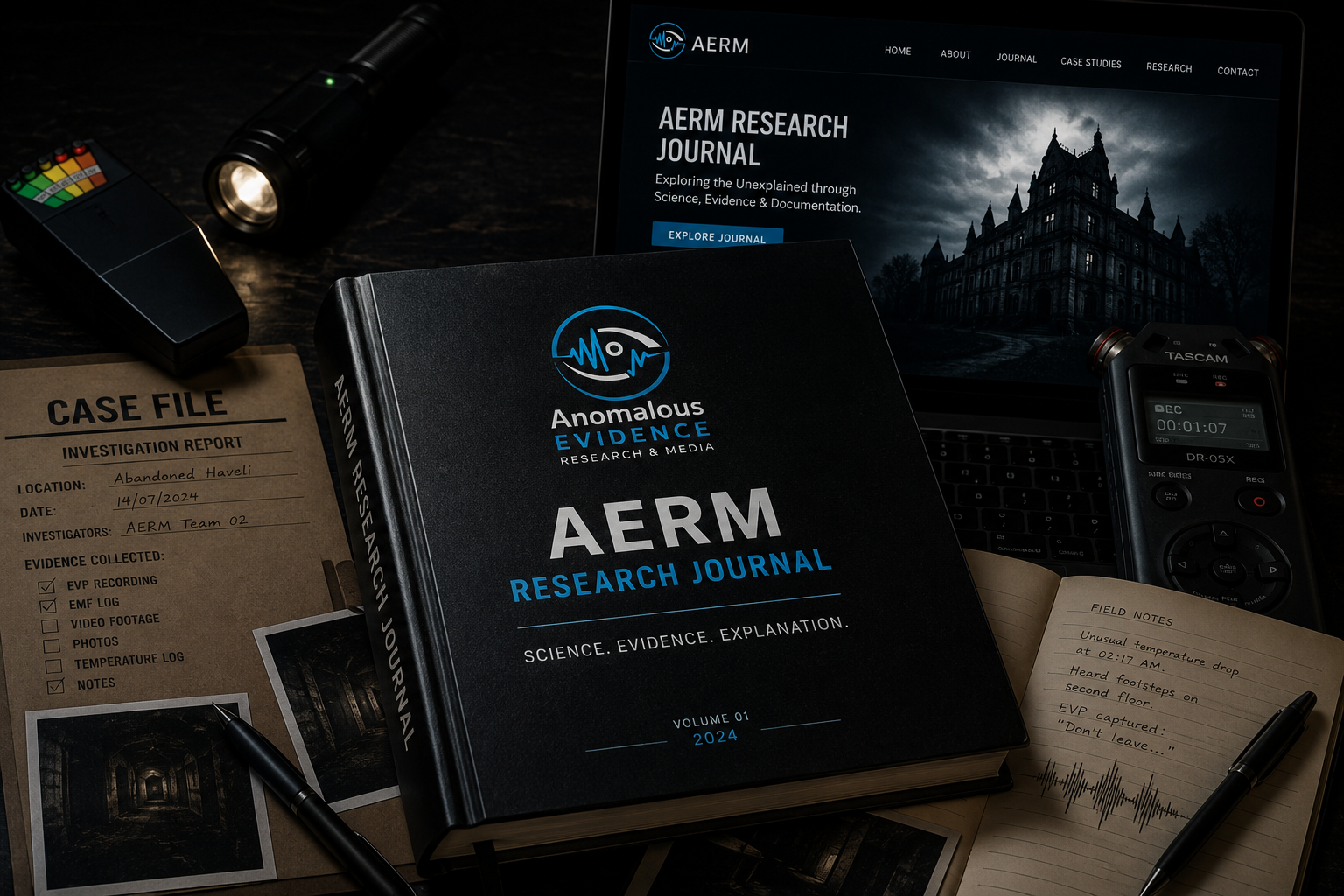
Case Study: Investigating Repeated Knocking Sounds in an Empty Corridor
Case overview
This training case describes a hypothetical investigation scenario. It is not presented as a real AERM finding. A site manager reports repeated knocking sounds in a corridor after normal working hours. The sound is described as three short knocks, sometimes followed by a longer pause.
Initial report
The team records the witness's account without suggesting a cause. The reported times, duration, location and perceived direction are entered into a log. Investigators distinguish the witness's direct observations from later interpretations.
Site survey
The corridor is mapped, including doors, windows, pipes, suspended ceilings, service shafts and nearby rooms. The team records building operating hours, HVAC schedules, water use, lifts and external traffic. Permission is confirmed before recording.
Hypotheses
Potential sources include pipe expansion, a door latch, loose ceiling components, a neighbouring room, external impact or an acoustic reflection. These are hypotheses to test, not assumed answers.
Measurement plan
Two audio recorders are placed at fixed positions. A vibration sensor is mounted on a stable surface near a suspected structural pathway. All devices are time-checked. The team records an unoccupied baseline and a comparison session during normal building operation.
Results framework
The analysis should identify whether knocks recur, whether they are recorded by both microphones, whether vibration coincides, and whether timing aligns with HVAC or water-system operation. If the event is not reproduced, the report must say so. If a likely source is identified, it should be tested by a controlled intervention conducted by authorised building staff.
Discussion
A sound heard by a witness is a valid report of an experience. The cause remains a separate question. Multiple sensors can strengthen the record, but only if their placement, timing and limitations are documented.
Lessons
- Map connected spaces and service routes.
- Record baseline conditions before interpreting events.
- Synchronise devices and preserve full recordings.
- Avoid telling reviewers what they are expected to hear.
- Do not manipulate building systems without permission.
Conclusion
This case illustrates a disciplined process: document the report, map the environment, test plausible sources and communicate uncertainty. The purpose is not to force a conventional explanation, but to establish what the available evidence supports.
References and Further Reading
- Kuttruff, H. Room Acoustics. CRC Press.
- ISO 3382-2. Measurement of room acoustic parameters—Reverberation time in ordinary rooms.
- NIST, digital evidence preservation resources.
AERM Research and Reporting Checklist
Before publication, confirm that the report:
- States the question and the observation separately from any interpretation.
- Identifies the location and conditions at a level that respects privacy and safety.
- Records equipment, settings, placement and known limitations.
- Preserves original files and documents any processing.
- Describes controls, alternative explanations and unsuccessful tests.
- Reports uncertainty and avoids claims stronger than the evidence.
- Has permission for all identifiable recordings, quotations and images.
AERM Core Principle: No anomaly is considered paranormal until environmental, psychological, technical, and scientific explanations have been systematically evaluated.
About AERM
Anomalous Evidence Research & Media (AERM) is a research and media initiative focused on structured investigation, evidence preservation and public science communication. Through its research publication work and the Paranormal Frame platform, AERM aims to make complex scientific ideas accessible while maintaining a clear distinction between observation, interpretation and established evidence.
Educational Disclaimer
This article is intended for education and research awareness. It is not a substitute for professional medical, engineering, electrical, legal, forensic or safety advice. Obtain appropriate permissions, follow applicable laws and standards, protect participant privacy, and consult qualified professionals whenever a task involves specialist risk.