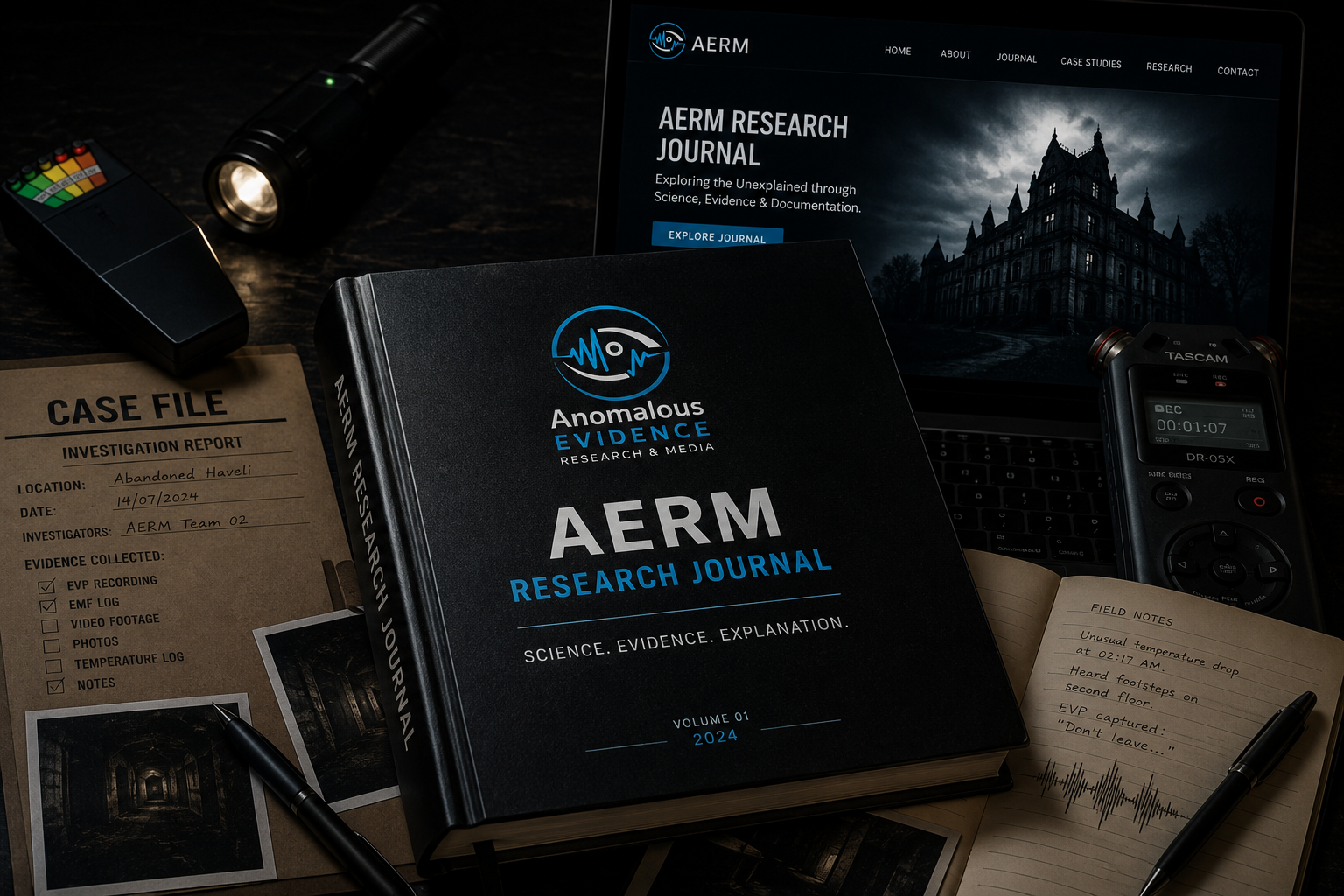
Case Study: Environmental Assessment of an Allegedly Haunted Abandoned School
This case study is published for educational purposes to demonstrate AERM's investigation methodology. Certain location details have been anonymized to protect privacy and preserve site integrity.
Case studies are an essential part of evidence-based research. They demonstrate how investigators collect, document, analyze, and interpret information while maintaining transparency throughout the investigative process.
This article presents a structured investigation conducted at an abandoned educational facility where repeated reports of unexplained sounds, shadows, and unusual environmental conditions had been documented by local visitors.
Rather than attempting to confirm paranormal claims, the objective was to evaluate all available evidence using systematic environmental investigation techniques.
---
Investigation Overview
Investigation Type: Environmental Assessment
Location: Abandoned Educational Facility (Name Withheld)
Investigation Duration: Approximately 5 Hours
Investigation Team: AERM Field Investigation Unit
Objective: Evaluate reported unexplained phenomena using environmental measurement, documentation, and evidence analysis.
---
Reported Activity
Witnesses described several recurring experiences, including:
- Footsteps in empty corridors
- Loud knocking sounds
- Sudden cold areas
- Shadow-like movement
- Feelings of being watched
These reports formed the basis of the investigation but were treated as observations requiring verification rather than established facts.
---
Investigation Planning
Before visiting the location, investigators completed:
- Historical background review
- Structural safety assessment
- Weather forecast analysis
- Equipment preparation
- Investigation objectives
- Risk assessment
A clear investigation plan ensures consistency and minimizes unnecessary assumptions during fieldwork.
---
Equipment Used
The investigation employed a combination of environmental monitoring and documentation tools, including:
- EMF Meter
- Lux Meter
- Thermal Imaging Camera
- Digital Voice Recorder
- Environmental Data Logger
- Infrared Camera
- DSLR Camera
- Tripod System
- Laser Distance Meter
Each instrument served a specific purpose within the overall investigation.
---
Environmental Baseline
Upon arrival, baseline environmental measurements were recorded before any detailed observations began.
Measurements included:
- Ambient temperature
- Relative humidity
- Light intensity
- EMF levels
- Weather conditions
- Wind direction
- Background sound levels.
These values established a reference point for later comparison.
---
Field Observations
The investigation was conducted in a systematic manner, dividing the building into multiple observation zones.
During the survey:
- Several knocking sounds were recorded.
- Multiple temperature differences were observed between rooms.
- Shadows were reported by two investigators.
- Elevated EMF readings were detected near an electrical distribution area.
Every observation was documented with timestamps, photographs, and environmental measurements.
---
Evidence Analysis
Each observation was independently evaluated.
Reported Footsteps
Investigation revealed that loose wooden flooring and structural movement caused by temperature changes produced sounds resembling footsteps.
Knocking Sounds
Audio analysis indicated irregular expansion and contraction of old building materials combined with wind-induced structural movement.
Cold Areas
Thermal imaging identified significant airflow entering through broken windows and roof openings.
Temperature differences matched the locations where witnesses had reported "cold spots."
Shadow Reports
Site inspection found multiple sources of moving shadows caused by passing vehicle headlights, tree movement, and changing outdoor illumination.
No unusual optical phenomena were documented beyond these environmental influences.
Elevated EMF Readings
Higher readings were consistently recorded near old electrical infrastructure.
Measurements returned to normal after increasing distance from these sources.
---
Alternative Explanations Considered
The investigation evaluated several conventional explanations, including:
- Structural movement
- Airflow
- Electrical interference
- Lighting conditions
- Wildlife activity
- Human perception
- Acoustic reflections
- Weather influence
Each factor was assessed before interpreting any observation.
---
Findings
Most reported experiences could be reasonably explained through documented environmental conditions.
No single observation provided sufficient evidence to support extraordinary conclusions.
Several observations remained inconclusive due to limited repeatability; however, inconclusive findings should not be interpreted as evidence of paranormal activity.
---
Lessons Learned
This investigation reinforced several important principles:
- Environmental measurements provide essential context.
- Witness experiences deserve careful documentation.
- Multiple data sources strengthen investigative conclusions.
- Ordinary environmental factors can produce unexpected observations.
- Transparent reporting is essential for credible research.
---
Investigation Outcome
Case Status: Explained / Partially Inconclusive
The majority of reported phenomena were consistent with identifiable environmental conditions documented during the investigation.
No verified evidence supporting extraordinary claims was identified during this assessment.
---
Conclusion
This case study demonstrates the importance of approaching unusual reports with curiosity, objectivity, and methodological discipline.
By combining environmental measurement, systematic documentation, and critical analysis, investigators can better distinguish between natural environmental influences and observations requiring further study.
Evidence-based investigation does not seek to prove or disprove extraordinary claims. Instead, it seeks to understand observations through careful examination of available evidence.
Every investigation should begin with questions—not conclusions.
---
Key Takeaways
- Always establish environmental baselines.
- Document every observation objectively.
- Evaluate conventional explanations first.
- Preserve all original evidence.
- Separate observations from interpretations.
- Accept uncertainty where evidence is insufficient.
---
About AERM
Anomalous Evidence Research & Media (AERM) is an independent research organization dedicated to investigating unexplained reports through scientific methodology, environmental analysis, critical thinking, and transparent documentation.
---
Educational Notice
This case study is intended to demonstrate investigative methodology and evidence evaluation. Certain identifying details have been intentionally withheld or anonymized to protect privacy, discourage unauthorized site visits, and maintain ethical research standards.