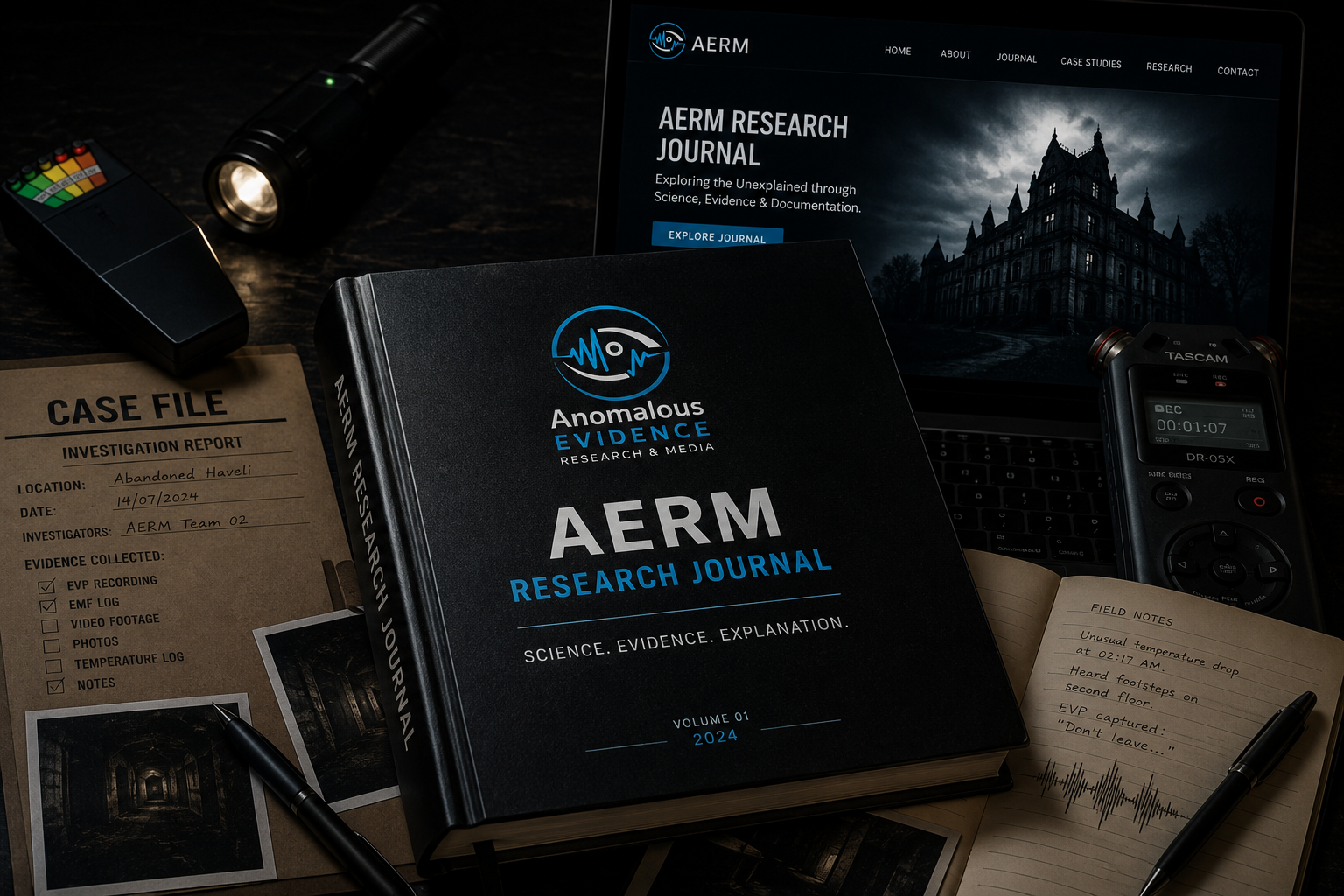
The AERM Field Research Standard: From First Observation to a Defensible Evidence Report
Why a field standard matters
An investigation is not defined by the number of devices carried into a building. It is defined by the quality of the question, the integrity of the observations and the transparency of the conclusion. This special feature presents a practical AERM framework that can be applied across audio, video, environmental monitoring and witness research.
1. Begin with a neutral claim
Translate the report into an observable statement. Replace “a spirit moves objects” with a description such as “a lightweight object was reported to change position between two documented observations.” Identify what is known, what is recalled and what remains uncertain.
2. Obtain permission and assess risk
Confirm access rights and the scope of permission. Complete a site-specific risk assessment. Identify structural, electrical, environmental and personal safety hazards. Establish an emergency plan and stop-work authority. Do not enter unsafe or restricted locations.
3. Survey the environment
Map the accessible site, connected rooms, openings, utilities, nearby infrastructure and sensor positions. Record weather, occupancy, lighting, ventilation and building operations. The environment is part of the measurement system.
4. Select instruments for a defined quantity
Choose each instrument because it measures something relevant to the question. Record make, model, range, resolution, accuracy specification, calibration status, sampling rate and known limitations. A device marketed for paranormal use should still be evaluated by its actual sensing principle.
5. Establish a baseline and controls
Record ordinary conditions before testing the claim. Define event criteria in advance. Use comparison locations or sessions where appropriate. Change one variable at a time whenever possible. Preserve null results and failed tests.
6. Protect witness accounts
Interview people independently where practical. Begin with free recall and neutral questions. Separate direct observation from interpretation. Obtain informed consent for recordings and publication. Do not pressure participants or use fear as a method.
7. Preserve digital evidence
Keep original recordings and photographs. Calculate hashes, maintain a chain-of-custody log and analyse verified copies. Document all edits, filters, exports and AI-assisted processing. A hash supports integrity after collection; it does not prove the original content was authentic.
8. Analyse without cherry-picking
Review complete sessions before selecting excerpts. Predefine thresholds and primary outcomes. Report all relevant comparisons, uncertainty and missing data. Use independent reviewers or blinded analysis where feasible. Treat automated alerts as leads for human verification.
9. Write a defensible report
A report should include the research question, site conditions, permissions, team roles, equipment, methods, results, alternative explanations, limitations, deviations from protocol and conclusion. Distinguish “not detected,” “not reproduced,” “unresolved” and “explained” rather than collapsing them into one label.
10. Communicate responsibly
Avoid claiming proof beyond the evidence. Protect identities and sensitive site information. Correct mistakes transparently. Provide enough methodological detail for another team to understand or repeat the work.
AERM's governing principle
No anomaly is considered paranormal until environmental, psychological, technical, and scientific explanations have been systematically evaluated.
This principle is not a slogan to place at the end of a report. It is a practical obligation that shapes every stage—from question design to publication.
Conclusion
A defensible investigation is a sequence of documented decisions. It starts with curiosity, uses methods that can fail, preserves evidence that may contradict expectations and ends with a conclusion proportionate to the data. The standard is not whether a session feels extraordinary. The standard is whether the evidence can withstand careful independent review.
References and Further Reading
- National Academies. Reproducibility and Replicability in Science.
- NIST SP 800-86. Guide to Integrating Forensic Techniques into Incident Response.
- ISO/IEC 27037. Digital evidence identification, collection, acquisition and preservation.
- JCGM 200. International Vocabulary of Metrology.
- Society of Professional Journalists. SPJ Code of Ethics.
AERM Research and Reporting Checklist
Before publication, confirm that the report:
- States the question and the observation separately from any interpretation.
- Identifies the location and conditions at a level that respects privacy and safety.
- Records equipment, settings, placement and known limitations.
- Preserves original files and documents any processing.
- Describes controls, alternative explanations and unsuccessful tests.
- Reports uncertainty and avoids claims stronger than the evidence.
- Has permission for all identifiable recordings, quotations and images.
AERM Core Principle: No anomaly is considered paranormal until environmental, psychological, technical, and scientific explanations have been systematically evaluated.
About AERM
Anomalous Evidence Research & Media (AERM) is a research and media initiative focused on structured investigation, evidence preservation and public science communication. Through its research publication work and the Paranormal Frame platform, AERM aims to make complex scientific ideas accessible while maintaining a clear distinction between observation, interpretation and established evidence.
Educational Disclaimer
This article is intended for education and research awareness. It is not a substitute for professional medical, engineering, electrical, legal, forensic or safety advice. Obtain appropriate permissions, follow applicable laws and standards, protect participant privacy, and consult qualified professionals whenever a task involves specialist risk.