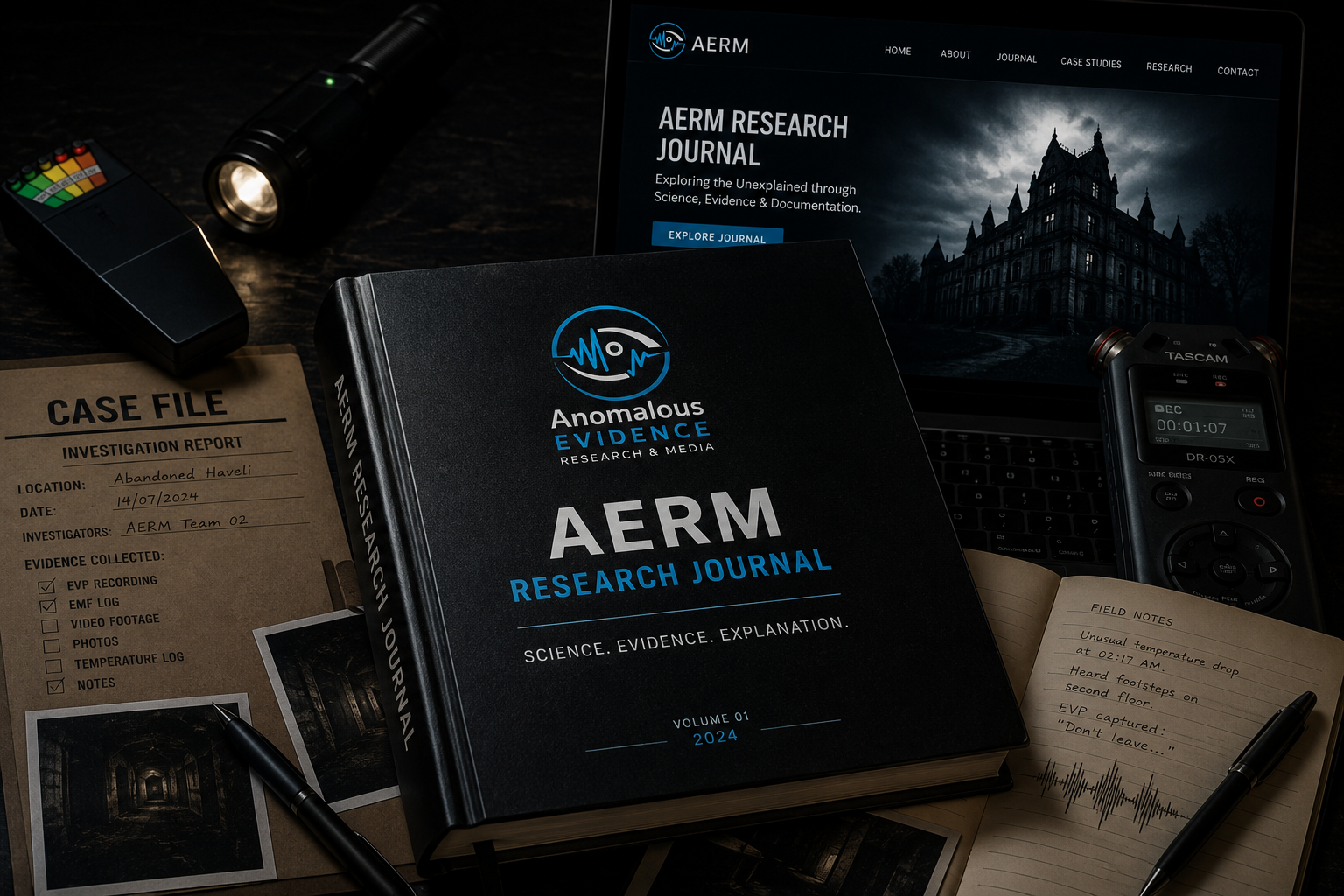
What to Expect from an AERM Investigation Workshop: Learning Evidence-Based Paranormal Investigation
A professional investigator is not defined by the equipment they carry, but by the methodology they follow.
Many people are fascinated by paranormal investigations after watching television programs or online videos. However, real investigations are far more structured than popular media often suggests.
At Anomalous Evidence Research & Media (AERM), our workshops are designed to introduce participants to the principles of evidence-based investigation. Rather than focusing on entertainment or sensational claims, the program emphasizes scientific observation, environmental analysis, critical thinking, ethical conduct, and responsible documentation.
Whether you are a student, researcher, content creator, or simply curious about investigation methodology, our workshops provide a structured learning experience grounded in professional practices.
---
Executive Summary
AERM workshops focus on:
- Scientific investigation methodology
- Environmental assessment
- Investigation planning
- Equipment familiarization
- Evidence collection
- Documentation standards
- Critical thinking
- Ethical investigation practices
- Report preparation
Participants learn how investigations are conducted, not how to "hunt ghosts."
---
Why Does AERM Conduct Workshops?
Education is one of the core objectives of AERM.
Many misconceptions exist regarding paranormal investigation, largely because of entertainment media and misinformation.
Our workshops aim to:
- Promote evidence-based investigation.
- Encourage scientific thinking.
- Improve public understanding.
- Develop responsible investigators.
- Teach practical field skills.
- Foster ethical research practices.
Our goal is not to convince participants of extraordinary claims but to teach them how such claims should be investigated responsibly.
---
Who Can Attend?
The workshop is suitable for:
- Students
- Researchers
- Science enthusiasts
- Psychology students
- Engineering students
- Photography enthusiasts
- Environmental researchers
- Content creators
- Aspiring investigators
No previous investigation experience is required.
Curiosity, professionalism, and a willingness to learn are the only prerequisites.
---
What Will Participants Learn?
The workshop introduces participants to the complete investigative workflow.
Topics typically include:
- Introduction to evidence-based investigation
- Planning an investigation
- Site assessment
- Environmental science
- Human perception and cognitive bias
- Equipment overview
- Documentation techniques
- Evidence collection
- Data analysis
- Report writing
- Investigation ethics
Each topic builds a foundation for responsible field investigations.
---
Understanding Investigation Equipment
Participants become familiar with commonly used investigative instruments, including:
- EMF Meters
- Lux Meters
- Thermal Imaging Cameras
- Digital Voice Recorders
- Environmental Data Loggers
- Hygrometers
- Infrared Cameras
- Laser Distance Meters
- DSLR Cameras
Rather than presenting these devices as "paranormal detectors," the workshop explains what they actually measure, their limitations, and how they contribute to environmental analysis.
---
Environmental Assessment
A significant portion of the workshop focuses on understanding environmental factors that may influence reported experiences
Participants learn how to evaluate:
- Temperature
- Humidity
- Light levels
- Electromagnetic fields
- Air quality
- Sound
- Structural conditions
- Weather influences
These measurements provide the context necessary for interpreting observations objectively.
---
Evidence Collection and Documentation
Good investigations rely on good documentation.
Participants learn how to:
- Record observations accurately.
- Photograph scenes systematically.
- Maintain investigation logs.
- Preserve digital evidence.
- Document environmental conditions.
- Organize investigation records.
Emphasis is placed on documenting facts rather than assumptions.
---
Critical Thinking and Scientific Methodology
One of the most important lessons taught during the workshop is how to think like an investigator.
Participants are encouraged to:
- Question assumptions.
- Evaluate evidence objectively.
- Consider alternative explanations.
- Recognize cognitive bias.
- Separate observations from interpretations.
Critical thinking is presented as an essential investigative skill.
---
Ethics and Professional Responsibility
Professional investigations require ethical standards.
The workshop discusses:
- Respect for property owners
- Privacy and confidentiality
- Informed consent
- Responsible communication
- Honest reporting
- Avoiding sensationalism
Maintaining public trust is a responsibility shared by every investigator.
---
Practical Demonstrations
Where appropriate, workshops may include practical demonstrations that allow participants to observe investigation procedures in a controlled learning environment.
Activities may include:
- Environmental measurements
- Equipment demonstrations
- Documentation exercises
- Evidence recording techniques
- Observation practice
- Data interpretation exercises
These sessions reinforce theoretical concepts through practical application.
---
What the Workshop Does Not Teach
AERM workshops do not teach:
- How to prove paranormal activity
- Rituals or occult practices
- Spirit communication techniques
- Supernatural claims presented as fact
- Entertainment-focused "ghost hunting"
Our workshops focus exclusively on responsible investigation and evidence-based methodology.
---
Skills Participants Develop
Upon completing the workshop, participants should have a better understanding of:
- Investigation planning
- Environmental awareness
- Evidence collection
- Documentation
- Critical thinking
- Ethical research
- Professional reporting
- Scientific observation
These skills are valuable not only in paranormal investigations but also in broader research and fieldwork.
---
Why Evidence-Based Training Matters
An investigator's credibility depends not on dramatic stories or expensive equipment but on their ability to document observations accurately and evaluate evidence objectively.
Structured training helps participants develop consistency, discipline, and analytical thinking—qualities essential for any form of scientific investigation.
---
Conclusion
Education is the foundation of responsible investigation.
By combining scientific methodology, environmental analysis, ethical practices, and critical thinking, AERM workshops prepare participants to approach unusual reports with professionalism rather than assumption.
Whether participants continue into research, investigation, or simply wish to better understand unexplained experiences, the knowledge gained provides a strong foundation for evidence-based inquiry.
The purpose of training is not to teach people what to believe—it is to teach them how to investigate responsibly.
---
Frequently Asked Questions
Is prior experience required?
No. The workshop is designed for beginners as well as individuals interested in structured investigation methods.
Will participants use professional equipment?
Yes. Equipment demonstrations and practical sessions introduce participants to commonly used environmental monitoring instruments.
Is the workshop science-based?
Yes. The curriculum emphasizes scientific methodology, environmental analysis, documentation, and critical thinking.
Does the workshop guarantee paranormal experiences?
No. The purpose of the workshop is education, not the pursuit of extraordinary experiences.
---
About AERM
Anomalous Evidence Research & Media (AERM) is an independent research organization dedicated to investigating unexplained reports through scientific methodology, environmental analysis, critical evaluation, and transparent documentation. Through workshops, research, and public education, AERM promotes responsible, evidence-based investigation practices.
---
Disclaimer
This workshop article is intended to describe the educational objectives of AERM's training programs. Workshop content may evolve as new research, technologies, and investigative methodologies become available. Participation in an AERM workshop does not certify expertise but provides foundational knowledge in evidence-based investigative practices.