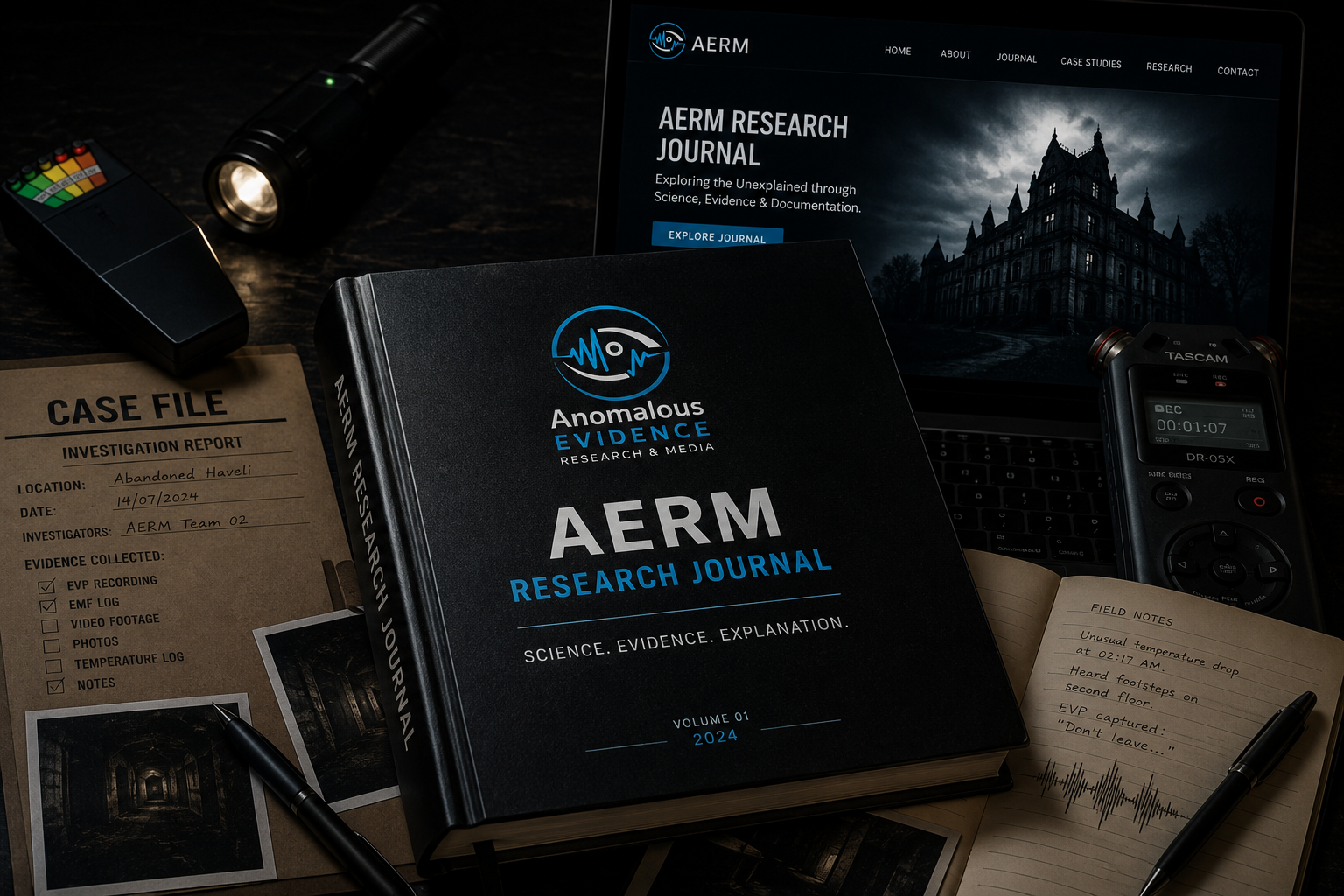
Ghost Hunting Myths vs Evidence: Separating Popular Beliefs from Scientific Investigation
Popular beliefs often shape expectations. Evidence-based investigation challenges those expectations through observation, measurement, and critical analysis.
Television programs, online videos, horror films, and social media have significantly influenced how the public perceives paranormal investigation. While these sources can generate curiosity, they also contribute to misconceptions about how professional investigations are actually conducted.
At Anomalous Evidence Research & Media (AERM), investigations are guided by scientific methodology, environmental assessment, and transparent documentation—not by assumptions or entertainment.
This article examines some of the most common myths surrounding paranormal investigation and compares them with evidence-based investigative practice.
---
Executive Summary
Professional investigations are built upon:
- Observation before interpretation
- Environmental measurement
- Evidence preservation
- Critical thinking
- Scientific documentation
Many commonly accepted beliefs about paranormal investigation are not supported by reliable evidence.
---
Myth 1: EMF Meters Detect Ghosts
Myth
An EMF meter will alert investigators whenever a ghost is nearby.
Fact
An EMF meter measures electromagnetic fields produced by electrical systems and electronic devices.
Common sources include:
- Electrical wiring
- Power outlets
- Transformers
- Wi-Fi routers
- Household appliances
- Mobile devices
While EMF measurements are valuable environmental data, there is currently no scientific evidence demonstrating that EMF meters detect paranormal entities.
---
Myth 2: Every Cold Spot Indicates Paranormal Activity
Myth
Sudden drops in temperature are proof of supernatural presence.
Fact
Temperature variations often result from:
- Air movement
- Open windows
- HVAC systems
- Building insulation
- Structural defects
- Weather conditions
Thermal imaging and environmental monitoring help investigators determine whether these changes have ordinary environmental causes.
---
Myth 3: Every Unexplained Sound Is Paranormal
Myth
Footsteps, knocks, whispers, and creaking sounds are evidence of haunting.
Fact
Buildings constantly produce sounds caused by:
- Thermal expansion
- Structural movement
- Plumbing
- Wind
- Wildlife
- Mechanical equipment
- Human activity
Professional investigators first examine these environmental factors before considering less conventional explanations.
---
Myth 4: Professional Investigators Always Work at Night
Myth
Real investigations can only be conducted after dark.
Fact
Many environmental assessments are actually more effective during daylight.
Daytime investigations allow teams to:
- Document structural conditions
- Map locations
- Identify environmental hazards
- Establish baseline measurements
- Locate potential sound and light sources
Night investigations are conducted only when they support the investigation objectives.
---
Myth 5: One Photograph Can Prove Paranormal Activity
Myth
A single unusual photograph is definitive evidence.
Fact
Images should always be evaluated carefully
Investigators consider:
- Camera settings
- Exposure
- Lens artifacts
- Dust
- Moisture
- Reflections
- Motion blur
- Environmental lighting
Photographs gain value when supported by additional evidence—not when viewed in isolation.
---
Myth 6: Unexplained Means Paranormal
Myth
If investigators cannot explain an observation, it must be paranormal.
Fact
An unexplained observation simply means that available evidence is currently insufficient to determine its cause.
Scientific investigation recognizes three possible outcomes:
- Explained
- Inconclusive
- Requires Further Investigation
Remaining unexplained does not automatically imply a supernatural origin.
---
Myth 7: More Equipment Means Better Evidence
Myth
Using more devices automatically produces better investigations.
Fact
Effective investigation depends on:
- Proper methodology
- Accurate documentation
- Investigator training
- Environmental awareness
- Objective analysis
Equipment supports investigation but cannot replace knowledge and critical thinking.
---
Myth 8: Investigators Try to Prove Ghosts Exist
Myth
The goal of every investigation is to confirm paranormal activity.
Fact
Responsible investigators do not begin with predetermined conclusions.
Instead, they seek to answer questions such as:
- What happened?
- Can it be documented?
- Can it be measured?
- What environmental factors exist?
- What explanations are supported by evidence?
Evidence—not belief—guides the investigation.
---
Why Myths Persist
Misconceptions continue because of several factors:
- Horror films
- Television entertainment
- Viral social media content
- Confirmation bias
- Misunderstood equipment
- Lack of scientific context
While these sources can spark public interest, they often simplify or dramatize the investigative process.
---
How AERM Approaches Investigations
At AERM, every investigation follows principles designed to improve reliability and transparency.
These include:
- Establishing environmental baselines.
- Recording objective observations.
- Preserving original evidence.
- Considering alternative explanations.
- Maintaining detailed documentation.
- Accepting uncertainty where evidence is insufficient.
This approach encourages responsible research rather than sensational conclusions.
---
Why Critical Thinking Matters
Critical thinking helps investigators distinguish between:
- Observation and interpretation
- Correlation and causation
- Evidence and opinion
- Possibility and probability
The ability to evaluate information objectively is one of the most valuable skills an investigator can develop.
---
Conclusion
Paranormal investigation is often misunderstood because entertainment media emphasizes dramatic outcomes over disciplined methodology.
Professional investigations require patience, careful observation, environmental analysis, and objective evaluation.
By questioning assumptions and following the available evidence, investigators contribute to a more informed understanding of unusual reports.
At AERM, our goal is not to reinforce myths but to replace them with knowledge supported by careful research and transparent methodology.
Question Extraordinary Claims. Examine Ordinary Explanations. Follow the Evidence.
---
Myth vs Fact Summary
| Myth | Evidence-Based Fact | |-------|---------------------| | EMF meters detect ghosts | EMF meters measure electromagnetic fields. | | Cold spots prove haunting | Temperature changes often have environmental causes. | | Every strange sound is paranormal | Buildings and the environment produce many ordinary sounds. | | Investigations must happen at night | Daytime investigations are equally valuable. | | One photograph proves everything | Evidence requires context and verification. | | Unexplained means paranormal | Unexplained simply means insufficient evidence. | | More equipment equals better investigations | Methodology matters more than equipment. | | Investigators seek proof of ghosts | Professional investigators seek evidence, not confirmation. |
---
References
The concepts discussed in this article are informed by scientific methodology, environmental science, cognitive psychology, acoustics, photography, and evidence-based investigative practices. Readers are encouraged to evaluate extraordinary claims using critical thinking, measurable evidence, and established scientific principles.
---
About AERM
Anomalous Evidence Research & Media (AERM) is an independent research organization dedicated to investigating unexplained reports through scientific methodology, environmental analysis, critical evaluation, and transparent documentation.
---
Disclaimer
This publication is intended for educational purposes. AERM neither promotes nor dismisses extraordinary claims without evidence. Our investigations are guided by observation, measurement, documentation, and critical analysis. Conclusions are based solely on the quality and reliability of available evidence.