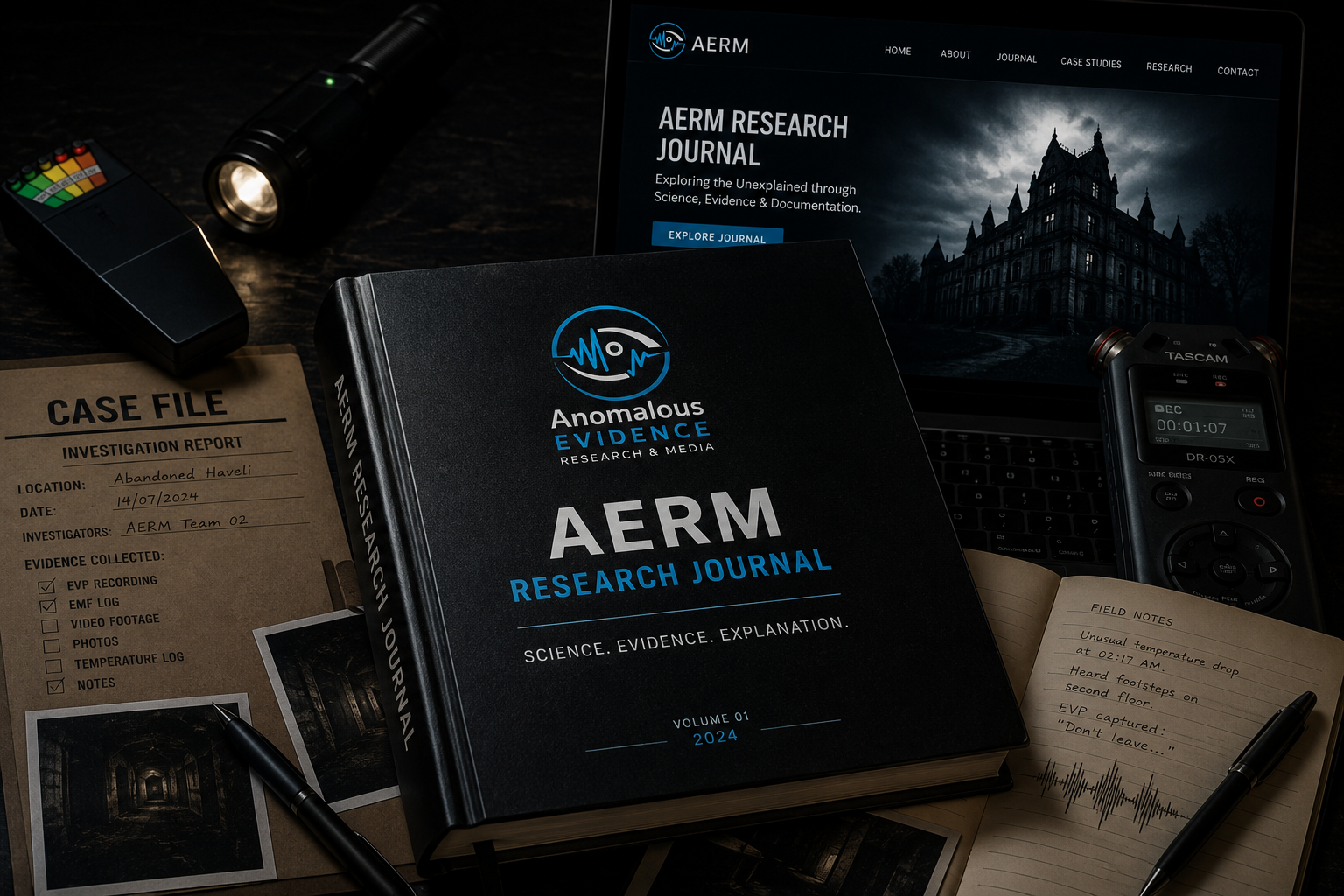
Environmental Investigation Methodology: An Evidence-Based Research Framework
Evidence before assumption. Observation before conclusion.
Paranormal claims often emerge from experiences that are emotionally powerful, personally meaningful, and difficult to explain. At AERM (Anomalous Evidence Research & Media), our objective is not to validate or dismiss these experiences but to investigate them using a structured, transparent, and evidence-based methodology.
Every investigation is approached with scientific curiosity, critical thinking, and professional documentation. Rather than seeking confirmation of extraordinary claims, we aim to identify the most plausible explanation supported by available evidence.
---
Executive Summary
AERM's investigation framework is built upon five fundamental principles:
- Objective observation
- Environmental measurement
- Evidence preservation
- Systematic analysis
- Transparent reporting
This methodology reduces investigator bias while improving the reliability, consistency, and reproducibility of every case study.
---
Why Methodology Matters
Without a standardized investigative process, observations can easily become influenced by expectations, assumptions, or incomplete information.
A structured methodology allows investigators to:
- Document observations consistently
- Preserve evidence integrity
- Reduce cognitive bias
- Compare findings across investigations
- Produce reports that are transparent and reproducible
The goal is not simply to collect unusual experiences but to understand them within their complete environmental and contextual framework.
---
Phase 1 — Case Assessment
Every investigation begins before investigators arrive at the location.
The initial assessment includes:
- Client interview
- Incident timeline
- Historical background
- Site information
- Previous investigations (if available)
- Safety assessment
- Investigation objectives
Defining the scope early ensures that the investigation remains focused and organized.
---
Phase 2 — Environmental Baseline Survey
Before collecting any paranormal-related observations, investigators establish a baseline of normal environmental conditions.
Typical measurements include:
- Ambient temperature
- Relative humidity
- Atmospheric pressure
- Light intensity
- Air quality
- Electromagnetic field (EMF)
- Background sound levels
- Structural vibration
- Weather conditions
These baseline measurements provide essential context for interpreting later observations.
---
Phase 3 — Controlled Observation
Investigators conduct systematic observations while minimizing unnecessary interference.
Field documentation includes:
- Exact timestamps
- Investigator positions
- Environmental changes
- Equipment status
- Witness observations
- Photographs
- Audio recordings
- Video recordings
Observations are documented exactly as experienced without immediately assigning paranormal explanations.
---
Phase 4 — Evidence Collection
Evidence is collected following standardized documentation procedures.
Examples include:
- Digital photographs
- Video recordings
- Audio recordings
- Environmental measurements
- Soil samples (where applicable)
- Water samples
- Material samples
- Physical traces
Whenever practical, evidence is preserved using a documented chain of custody to maintain integrity throughout the investigation.
---
Phase 5 — Comparative Analysis
Collected data is evaluated against conventional explanations before considering anomalous interpretations.
Investigators examine factors such as:
- Lighting conditions
- Shadow behavior
- Reflective surfaces
- Acoustic reflections
- Structural movement
- Wildlife activity
- Mechanical equipment
- Electrical systems
- Meteorological influences
- Human perception
- Psychological factors
This process helps distinguish unusual observations from naturally occurring environmental phenomena.
---
Documentation Standards
Every case file follows a consistent reporting structure to ensure clarity and reproducibility.
Reports typically include:
- Investigation objectives
- Site description
- Environmental baseline
- Equipment used
- Observation log
- Collected evidence
- Data analysis
- Alternative explanations considered
- Conclusions
- Recommendations
Consistency across reports allows future investigations to compare findings using standardized criteria.
---
Evidence Classification
Not every unusual observation represents unexplained activity.
AERM classifies findings into categories such as:
Explained
Observations that can be attributed to identifiable environmental or human causes.
Inconclusive
Evidence that lacks sufficient information for a reliable conclusion.
Under Further Review
Cases requiring additional investigation or independent verification.
Anomalous
Observations that remain unexplained after thorough environmental and analytical review.
An anomalous classification does not imply paranormal origin; it simply indicates that available evidence has not yet produced a satisfactory conventional explanation.
---
Research Ethics
Professional investigations require ethical responsibility.
AERM follows principles that include:
- Respect for property owners
- Informed consent
- Confidentiality where required
- Accurate reporting
- No evidence manipulation
- No sensationalism
- Transparent methodology
- Honest communication of limitations
Maintaining public trust is as important as collecting quality evidence.
---
Limitations
Every investigation has practical limitations.
Factors that may affect conclusions include:
- Limited access to locations
- Weather variability
- Equipment limitations
- Witness memory
- Environmental changes over time
- Restricted observation periods
Recognizing these limitations strengthens the credibility of the final report.
---
Continuous Improvement
Methodologies evolve as new research, technologies, and analytical techniques become available.
AERM regularly reviews and refines its investigative procedures to improve:
- Data quality
- Documentation standards
- Environmental analysis
- Evidence preservation
- Reporting consistency
Continuous improvement is fundamental to responsible research.
---
Conclusion
Investigating unexplained claims requires patience, objectivity, and disciplined methodology.
By emphasizing observation over assumption and evidence over speculation, AERM seeks to contribute meaningful, transparent, and scientifically grounded research to the study of anomalous reports
Our commitment remains unchanged:
Evidence Before Assumption.
---
References
The methodology described in this article is informed by established practices in environmental observation, scientific documentation, forensic evidence management, and critical investigative procedures. Future publications will include detailed references to relevant academic literature and technical standards where appropriate.
---
About AERM
Anomalous Evidence Research & Media (AERM) is an independent research organization dedicated to the systematic investigation of unexplained reports through evidence-based methodology, environmental analysis, and transparent documentation.
---
Disclaimer
This article is intended for educational and research purposes. AERM does not claim that unexplained observations constitute evidence of paranormal phenomena. Conclusions are based solely on the quality of available evidence and documented investigative findings.