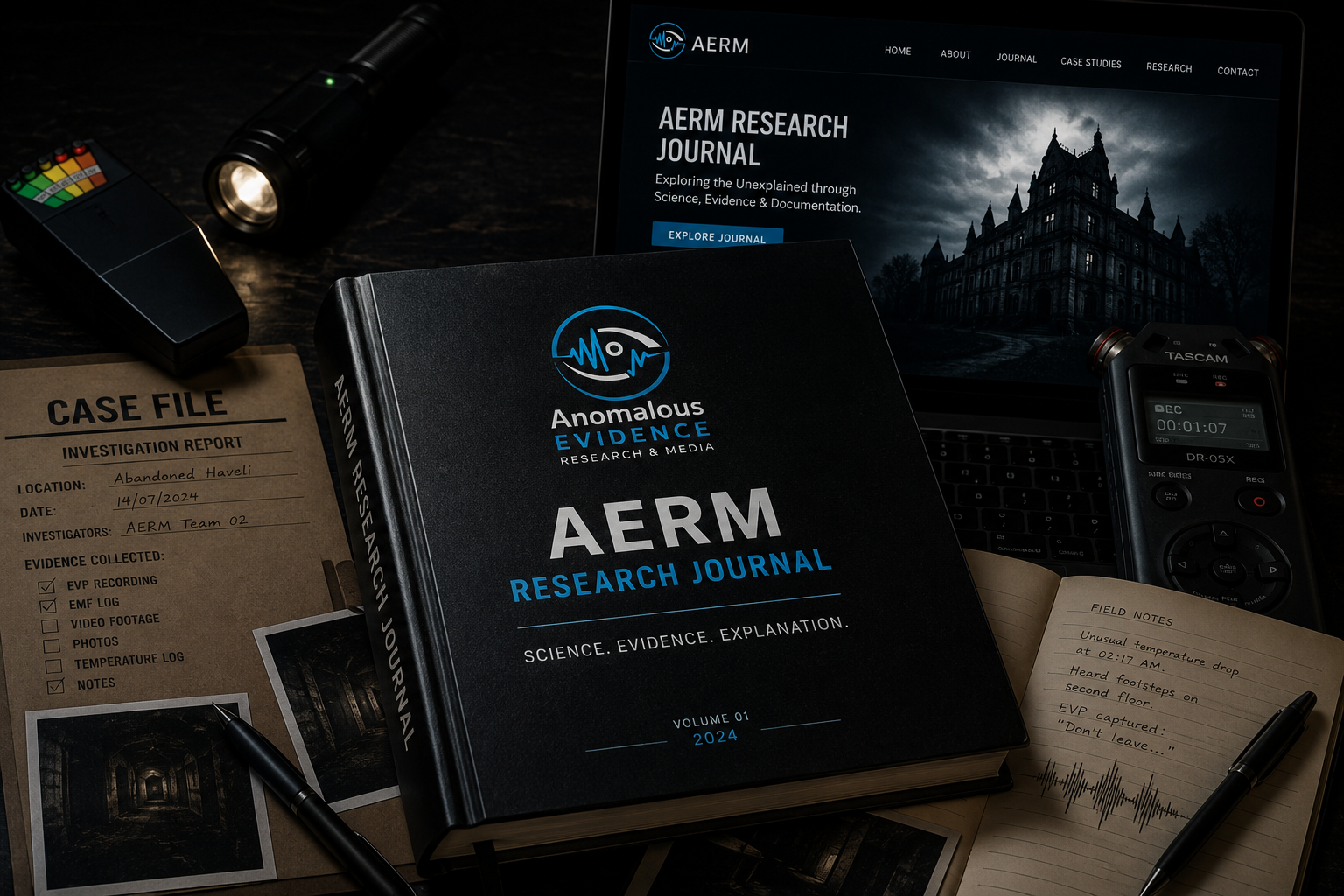
Understanding EMF Meters in Paranormal Investigations: Principles, Applications, and Limitations
An EMF meter measures electromagnetic fields—not paranormal activity. Understanding the difference is essential for responsible investigation.
Among all the equipment used during paranormal investigations, the Electromagnetic Field (EMF) meter is perhaps the most recognized—and one of the most misunderstood. Popular media often portrays EMF spikes as direct evidence of paranormal presence. However, there is currently no scientifically established evidence demonstrating that electromagnetic field fluctuations indicate paranormal phenomena.
At Anomalous Evidence Research & Media (AERM), EMF meters are used as environmental assessment instruments, not as paranormal detectors. Their primary purpose is to identify, document, and understand electromagnetic sources that may influence both the environment and human perception.
This article explains what an EMF meter measures, how it works, where it should be used, its limitations, and why evidence-based interpretation is essential.
---
Executive Summary
EMF meters are valuable environmental instruments that help investigators:
- Measure electromagnetic field strength.
- Identify electrical interference.
- Document environmental conditions.
- Locate hidden electrical sources.
- Rule out environmental factors before considering unusual explanations.
An EMF reading alone should never be interpreted as evidence of paranormal activity.
---
What is an Electromagnetic Field?
Electromagnetic fields (EMFs) are invisible areas of energy produced whenever electricity is generated, transmitted, or used.
Common sources include:
- Household electrical wiring
- Power outlets
- Distribution panels
- Electrical transformers
- Mobile phones
- Wi-Fi routers
- Bluetooth devices
- Television equipment
- Microwave ovens
- Refrigerators
- Air conditioners
- Computers
- Electric motors
- Power lines
These fields exist naturally in modern environments and vary depending on electrical activity.
---
What Does an EMF Meter Measure?
An EMF meter measures the strength of electromagnetic fields surrounding electrical devices and installations.
Depending on the model, it may measure:
- Magnetic Fields (µT or mG)
- Electric Fields (V/m)
- Radio Frequency (RF) signals
- Combined electromagnetic exposure
Each measurement represents environmental electrical activity—not unexplained phenomena.
---
Why Does AERM Use EMF Meters?
Environmental assessment is a fundamental part of every investigation.
EMF measurements help investigators:
- Establish environmental baselines.
- Detect faulty electrical wiring.
- Locate hidden electrical equipment.
- Identify electrical interference affecting recording devices.
- Compare readings across different locations.
- Document measurable environmental variables.
These observations provide important context when evaluating reported experiences.
---
Establishing an Environmental Baseline
Before any investigation begins, AERM records baseline environmental conditions.
Typical baseline measurements include:
- Ambient temperature
- Relative humidity
- Air pressure
- Light intensity
- Sound levels
- Air quality
- Electromagnetic field levels
Baseline measurements allow investigators to determine whether later changes are unusual or simply part of the normal environment
---
Common Sources of Elevated EMF Readings
High EMF readings are frequently caused by ordinary electrical infrastructure.
Examples include:
- Electrical distribution panels
- Extension cords
- Hidden wiring
- Smart meters
- Power adapters
- Transformers
- Industrial equipment
- Elevator motors
- HVAC systems
- Underground electrical cables
For this reason, investigators should always inspect the surrounding environment before drawing conclusions.
---
EMF and Human Perception
Several scientific studies have explored whether strong electromagnetic fields may influence human perception under certain conditions.
While research continues, some investigations suggest that high EMF exposure in specific environments may contribute to sensations such as:
- Headaches
- Dizziness
- Tingling sensations
- Difficulty concentrating
- Feelings of unease
These experiences are not evidence of paranormal activity and should always be considered alongside other environmental and physiological factors.
---
Proper Investigation Procedure
AERM follows a systematic process when using EMF meters.
Step 1 — Instrument Calibration
Ensure the device is functioning correctly and has sufficient battery power.
Step 2 — Baseline Measurement
Record background EMF levels before the investigation begins.
Step 3 — Environmental Survey
Scan walls, electrical panels, ceilings, floors, appliances, and nearby equipment.
Step 4 — Documentation
Record:
- Time
- Location
- Reading values
- Environmental conditions
- Nearby electrical sources
Step 5 — Verification
Repeat measurements from multiple positions to confirm consistency.
Step 6 — Comparative Analysis
Compare EMF data with:
- Audio recordings
- Video recordings
- Temperature measurements
- Witness reports
- Environmental observations
Only after considering all available information should investigators interpret the findings.
---
Common Mistakes During EMF Investigations
Reliable investigations require avoiding common errors, including:
- Treating every EMF spike as paranormal.
- Ignoring nearby electrical sources.
- Failing to establish baseline readings.
- Using low-quality or uncalibrated equipment.
- Relying on a single measurement.
- Ignoring environmental context.
- Drawing conclusions without supporting evidence.
Objective interpretation is essential.
---
Limitations of EMF Meters
EMF meters are highly useful environmental tools, but they have important limitations.
They cannot:
- Detect ghosts.
- Confirm paranormal activity.
- Identify supernatural entities.
- Determine the cause of unusual experiences.
- Replace comprehensive environmental investigation.
They measure only electromagnetic field strength.
Any interpretation beyond that requires additional evidence and careful analysis.
---
Integrating EMF Data with Other Evidence
AERM never evaluates EMF readings in isolation.
Instead, investigators compare EMF data with:
- Environmental measurements
- Acoustic analysis
- Thermal observations
- Photographic evidence
- Video recordings
- Witness interviews
- Historical information
- Structural inspections
This multidisciplinary approach produces more reliable and scientifically defensible conclusions.
---
Best Practices
To ensure accurate and consistent measurements, investigators should:
- Calibrate equipment before use.
- Record baseline conditions.
- Document every reading with timestamps.
- Repeat measurements.
- Investigate potential electrical sources.
- Preserve all raw data.
- Avoid confirmation bias.
- Compare findings with other environmental measurements.
Consistency improves the credibility of the investigation.
---
Conclusion
EMF meters are valuable scientific instruments for documenting environmental electromagnetic conditions. They are not designed to detect paranormal phenomena, nor should their readings be interpreted as standalone evidence of extraordinary events.
At AERM, EMF measurements form one component of a broader evidence-based investigative framework that prioritizes observation, environmental analysis, and critical evaluation over assumption.
By understanding both the capabilities and limitations of EMF meters, investigators can produce more objective, transparent, and scientifically responsible findings.
Evidence Before Assumption. Every Reading Requires Context.
---
References
This article is informed by established principles of electromagnetism, environmental measurement, electrical safety, and evidence-based investigative methodology. Readers are encouraged to consult peer-reviewed scientific literature, engineering references, and manufacturer documentation for detailed technical information regarding electromagnetic field measurement.
---
About AERM
Anomalous Evidence Research & Media (AERM) is an independent research organization dedicated to investigating unexplained reports through environmental analysis, scientific methodology, critical thinking, and transparent documentation.
---
Disclaimer
This article is intended for educational and research purposes. AERM does not claim that electromagnetic field fluctuations indicate paranormal activity. EMF measurements should always be interpreted within the broader context of environmental conditions, supporting evidence, and established scientific principles.