Choosing a Field Audio Recorder: Features That Matter More Than Marketing
A field recorder is not defined by how many microphones or dramatic modes it advertises. For research, the important features are predictable recording behaviour, usable preamps, reliable storage, manual control and transparent file formats.
Start with the recording objective. Capturing general ambience is different from documenting faint sounds at a fixed location or recording an interview. A recorder with manual gain, headphone monitoring, clear level meters and uncompressed WAV support is often more useful than a device that applies aggressive automatic processing.
Key specifications. Sample rate and bit depth describe digital representation, but higher numbers do not automatically produce better recordings. Microphone self-noise, preamplifier noise, microphone placement and room conditions may dominate. Two-channel stereo can help preserve spatial context, while multiple inputs are useful for synchronised microphones. Check whether the device records separate tracks or mixes them.
Practical features. Look for a locking or protected record control, battery indicator, time display, replaceable storage, headphone output, input-level control and a clear file-naming system. Check supported memory-card types and maximum capacities. Confirm that the device can record for the planned session length without splitting files unexpectedly.
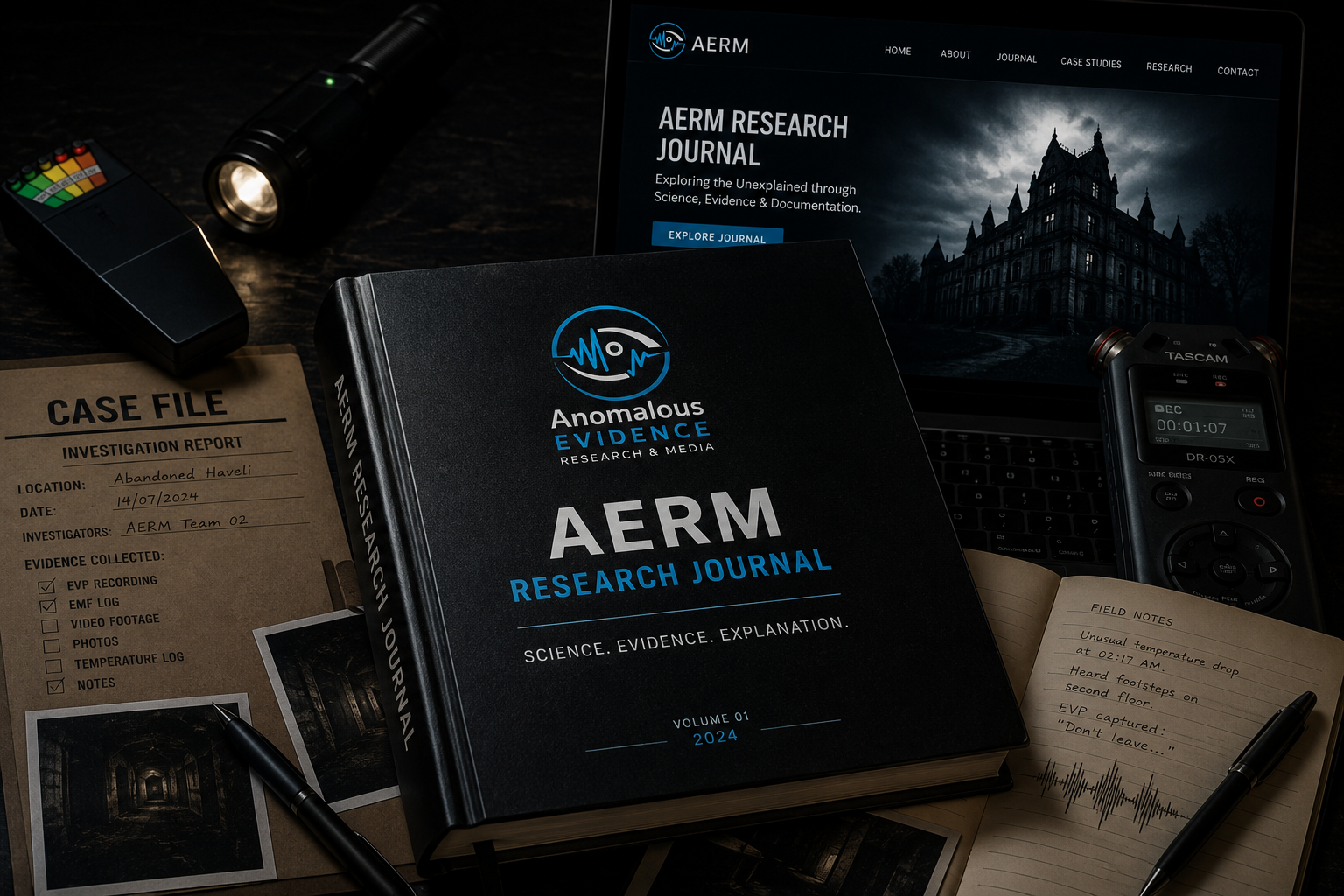
AERM equipment checklist. Before purchase, read the full manual; test the recorder with headphones; inspect handling noise; record a quiet room; test file transfer; verify timestamps; and confirm that the original files open in independent software. Carry spare batteries, memory cards and a written equipment log.
Field setup. Mount the recorder on a stable support, keep it away from clothing and loose cables, note microphone orientation and record a spoken slate at the start. A spoken slate should identify the session without revealing private information. Monitor levels to avoid clipping, but do not adjust gain unpredictably during a critical recording.
Limitations. Built-in microphones may be convenient but can capture handling noise and have limited low-frequency response. Automatic gain control may raise background noise during quiet intervals. Wind protection is essential outdoors. A recorder cannot determine whether a sound is paranormal; it only captures acoustic pressure variations within its capabilities.
Conclusion. Choose a recorder for the evidence you need to preserve, not for its feature count. Reliability, manual control, monitoring and careful documentation are the priorities.
References and Further Reading
- Rumsey, F. and McCormick, T. Sound and Recording: An Introduction. Focal Press.
- AES technical resources on digital audio recording.
- Manufacturer manuals for the selected recorder and microphone.
AERM Research and Reporting Checklist
Before publication, confirm that the report:
- States the question and the observation separately from any interpretation.
- Identifies the location and conditions at a level that respects privacy and safety.
- Records equipment, settings, placement and known limitations.
- Preserves original files and documents any processing.
- Describes controls, alternative explanations and unsuccessful tests.
- Reports uncertainty and avoids claims stronger than the evidence.
- Has permission for all identifiable recordings, quotations and images.
AERM Core Principle: No anomaly is considered paranormal until environmental, psychological, technical, and scientific explanations have been systematically evaluated.
About AERM
Anomalous Evidence Research & Media (AERM) is a research and media initiative focused on structured investigation, evidence preservation and public science communication. Through its research publication work and the Paranormal Frame platform, AERM aims to make complex scientific ideas accessible while maintaining a clear distinction between observation, interpretation and established evidence.
Educational Disclaimer
This article is intended for education and research awareness. It is not a substitute for professional medical, engineering, electrical, legal, forensic or safety advice. Obtain appropriate permissions, follow applicable laws and standards, protect participant privacy, and consult qualified professionals whenever a task involves specialist risk.