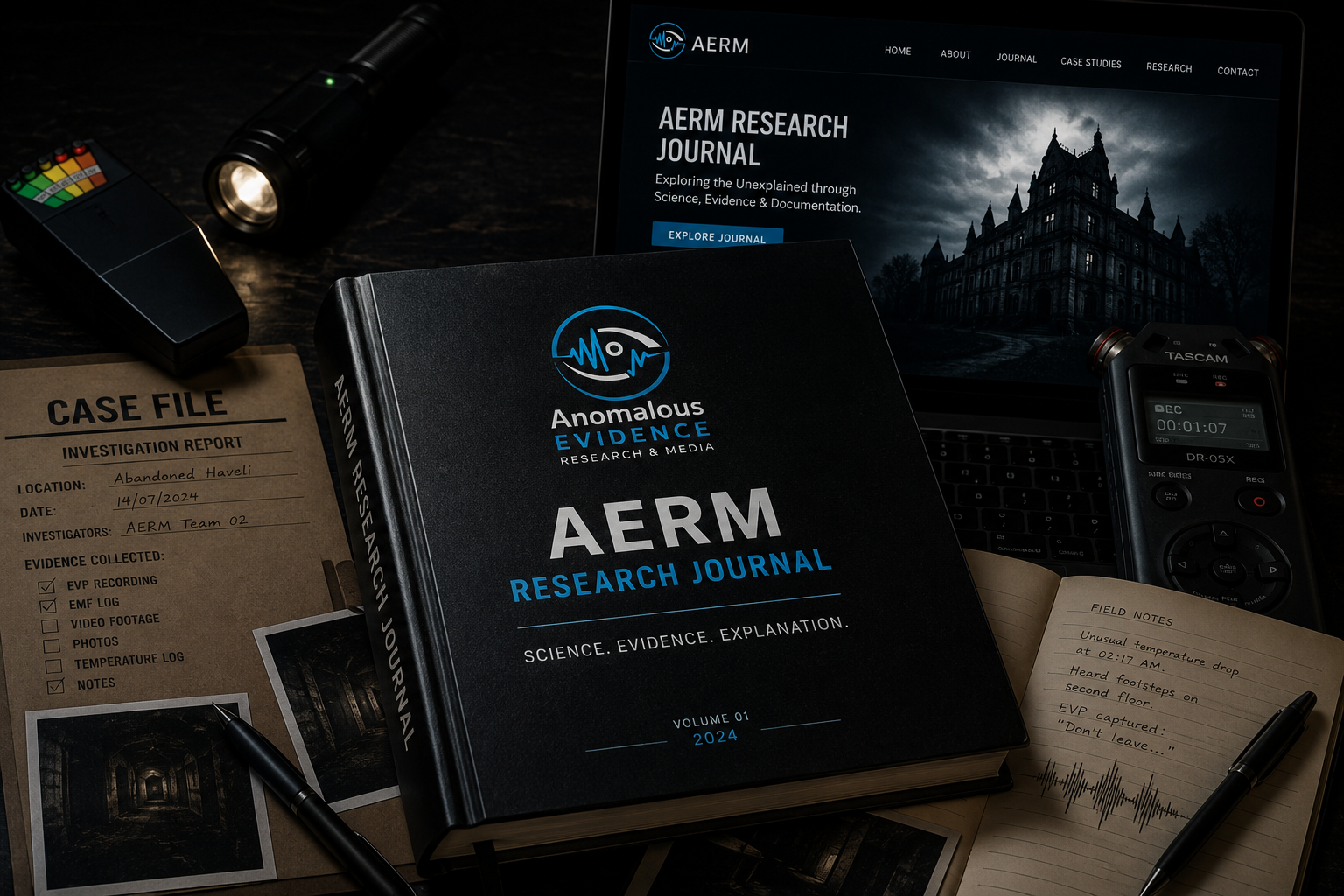
Evidence Analysis in Paranormal Investigations: From Observation to Evidence-Based Conclusions
Collecting evidence is only the beginning. Understanding what the evidence actually represents is where investigation truly begins.
In any scientific investigation, evidence has little value without careful analysis. A photograph, an audio recording, an environmental measurement, or a witness statement does not automatically explain an event. Instead, each piece of information must be examined critically, compared with other observations, and interpreted within its environmental context.
At Anomalous Evidence Research & Media (AERM), evidence analysis is a structured process designed to transform raw observations into informed conclusions while minimizing bias and maintaining transparency.
---
Executive Summary
Evidence analysis allows investigators to:
- Evaluate the reliability of collected data.
- Compare multiple sources of evidence.
- Identify environmental influences.
- Reduce subjective interpretation.
- Produce objective and reproducible conclusions.
Reliable conclusions depend on the quality of analysis—not simply the quantity of collected evidence.
---
What is Evidence Analysis?
Evidence analysis is the systematic examination of all information collected during an investigation.
Rather than asking:
"What do we want this evidence to prove?"
Investigators ask:
"What does this evidence objectively demonstrate?"
This distinction is fundamental to responsible scientific inquiry.
---
Types of Evidence
Professional investigations often involve multiple forms of evidence.
Examples include:
- Digital photographs
- Video recordings
- Audio recordings
- Environmental measurements
- Thermal images
- EMF readings
- Light measurements
- Weather data
- Structural observations
- Witness interviews
- Historical documentation
Each type of evidence has strengths, limitations, and appropriate methods of analysis.
---
Observation vs Interpretation
One of the most common mistakes in investigations is confusing observations with interpretations.
For example:
Observation:
"A knocking sound was recorded at 21:14."
Interpretation:
"The knocking sound was produced by paranormal activity."
The first statement describes what was documented.
The second proposes a possible explanation.
Professional investigators always separate observations from interpretations until sufficient evidence supports a conclusion.
---
Evaluating Evidence Reliability
Not all evidence carries the same level of reliability.
Investigators consider factors such as:
- Source credibility
- Data quality
- Recording conditions
- Environmental context
- Repeatability
- Independent verification
- Equipment limitations
Reliable evidence should be consistent, well-documented, and capable of independent review.
---
Correlation Does Not Equal Causation
Two events occurring together do not necessarily share a causal relationship.
For example:
An EMF increase recorded at the same time as an unusual sound does not automatically indicate that one caused the other.
Investigators must determine whether the relationship is:
- Coincidental
- Environmental
- Mechanical
- Human-induced
- Supported by additional evidence
Careful analysis prevents premature conclusions.
---
Comparative Evidence Analysis
Individual observations rarely provide complete answers.
AERM compares multiple sources of evidence simultaneously, including:
- Environmental measurements
- Audio recordings
- Video documentation
- Thermal imaging
- Witness statements
- Historical records
- Building inspections
Agreement across independent sources increases confidence in the findings.
---
Considering Alternative Explanations
Every observation should be evaluated against conventional explanations before extraordinary interpretations are considered.
Investigators assess:
- Electrical systems
- Airflow
- Weather conditions
- Wildlife
- Building materials
- Human activity
- Optical effects
- Acoustic reflections
- Equipment artifacts
Considering these possibilities strengthens the credibility of the investigation
---
Managing Investigator Bias
Evidence should never be analyzed with the intention of confirming existing beliefs.
Professional investigators should:
- Review evidence objectively.
- Document uncertainties.
- Invite peer review.
- Accept inconclusive findings.
- Avoid selective reporting.
Objectivity is essential for maintaining scientific integrity.
---
Common Mistakes in Evidence Analysis
Investigators should avoid:
- Drawing conclusions from a single observation.
- Ignoring environmental context.
- Overlooking equipment limitations.
- Selecting evidence that supports only one theory.
- Treating coincidence as proof.
- Assuming unexplained means paranormal.
A disciplined analytical process reduces these risks.
---
Best Practices
Effective evidence analysis includes:
- Preserving original files.
- Maintaining complete documentation.
- Recording timestamps.
- Comparing multiple data sources.
- Repeating measurements where possible.
- Reviewing findings independently.
- Clearly documenting limitations.
These practices improve reliability and transparency.
---
Reporting Findings
Professional reports should distinguish between:
- Documented observations
- Verified measurements
- Analytical findings
- Reasonable interpretations
- Confirmed conclusions
- Remaining uncertainties
Clear reporting enables readers to understand how conclusions were reached.
---
Limitations of Evidence
Every investigation has limitations.
Evidence may be affected by:
- Equipment sensitivity
- Environmental variability
- Limited observation time
- Human perception
- Recording quality
- Incomplete information
Acknowledging these limitations improves the credibility of the final report.
---
Conclusion
Evidence analysis is the bridge between observation and understanding.
By evaluating information systematically, considering alternative explanations, and maintaining methodological transparency, investigators can produce findings that are more reliable, objective, and scientifically defensible.
At AERM, conclusions are never based on isolated observations. They are built through careful analysis, environmental context, and evidence that can withstand critical examination.
Evidence is valuable only when it is analyzed objectively, documented transparently, and interpreted responsibly.
---
Key Principles of Evidence Analysis
- Collect evidence systematically.
- Preserve original data.
- Separate observation from interpretation.
- Compare multiple evidence sources.
- Consider conventional explanations first.
- Document uncertainty honestly.
- Reach conclusions only when supported by evidence.
---
References
The concepts discussed in this article are informed by established principles of scientific methodology, forensic evidence evaluation, environmental science, critical thinking, and investigative research. Readers are encouraged to consult peer-reviewed literature on evidence assessment, cognitive bias, and research methodology for deeper study.
---
About AERM
Anomalous Evidence Research & Media (AERM) is an independent research organization dedicated to investigating unexplained reports through scientific methodology, environmental analysis, evidence-based evaluation, and transparent documentation.
---
Disclaimer
This publication is intended for educational and research purposes. Evidence discussed within this article should not be interpreted in isolation or as proof of paranormal phenomena. AERM evaluates all observations within the broader context of environmental conditions, documented data, and established scientific principles before reaching conclusions.