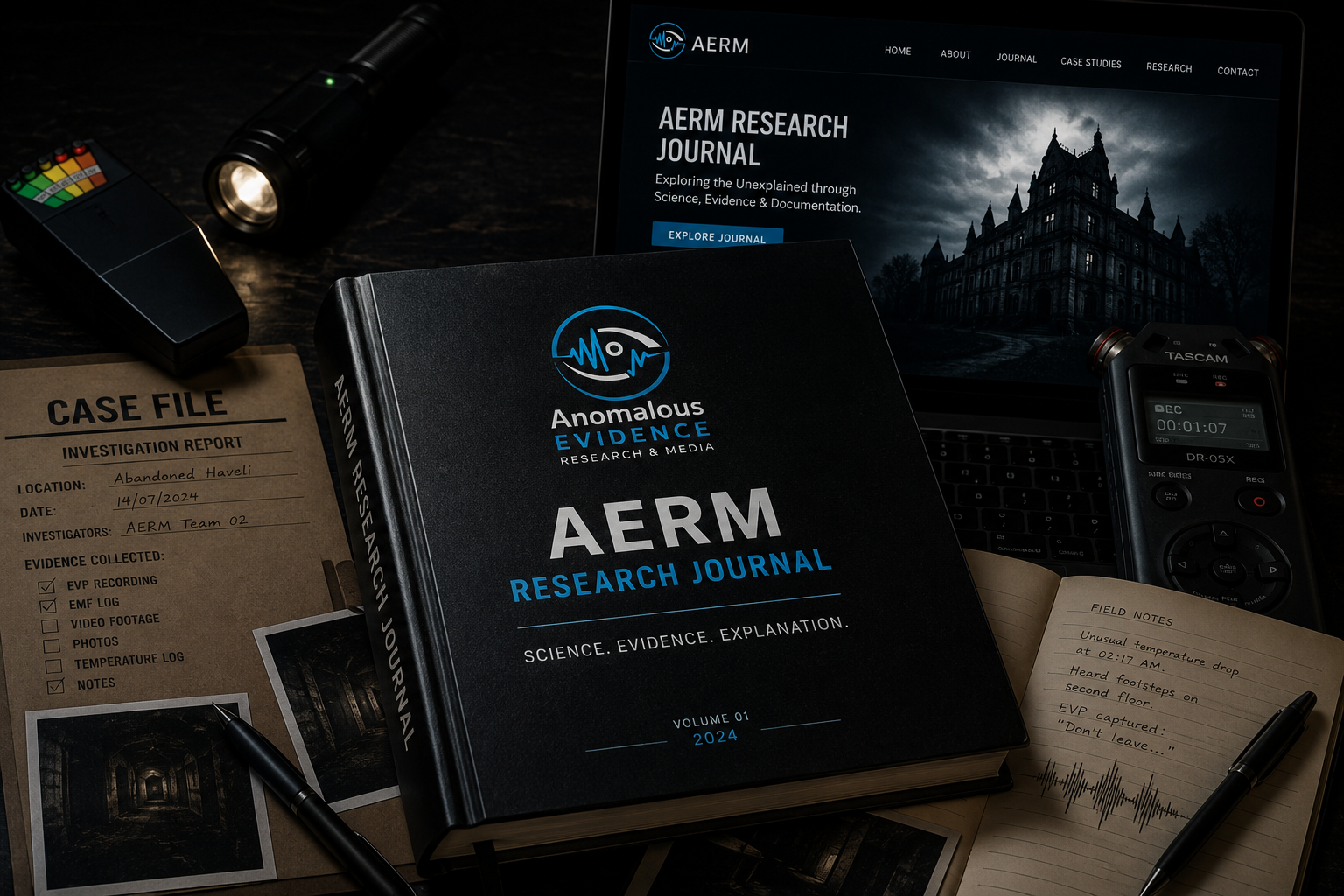
Equipment Reviews in Evidence-Based Investigations: A Scientific Framework for Evaluating Investigation Tools
An investigation is only as reliable as the quality of the evidence—and evidence depends on the quality of the tools used to collect it.
Choosing investigation equipment is often confusing for beginners. Marketing claims, social media videos, and entertainment-focused content frequently present devices as "ghost detectors" or guarantee extraordinary results.
Professional investigations require a different approach.
At Anomalous Evidence Research & Media (AERM), equipment is evaluated using measurable performance criteria rather than marketing language. Every instrument is considered a scientific tool designed to collect environmental data—not to confirm paranormal claims.
This article explains the framework AERM uses to evaluate investigation equipment objectively.
---
Executive Summary
Every piece of equipment should be evaluated for:
- Accuracy
- Reliability
- Repeatability
- Build quality
- Environmental suitability
- Ease of operation
- Data quality
- Documentation capability
- Maintenance requirements
- Overall investigative value
No device should be judged solely by popularity or price.
---
Why Equipment Reviews Matter
Investigation equipment directly affects the quality of collected evidence.
Poor-quality instruments may produce:
- False readings
- Inconsistent measurements
- Data loss
- Misleading observations
- Reduced investigation reliability
Objective evaluation helps investigators select equipment appropriate for their research objectives.
---
Review Principle 1 — Accuracy
The primary purpose of any scientific instrument is accurate measurement.
During evaluation, investigators should ask:
- Does the device measure what it claims?
- Are readings consistent?
- Can results be verified?
- Does the instrument meet manufacturer specifications?
Accuracy should always take priority over appearance or popularity.
---
Review Principle 2 — Reliability
Reliable equipment performs consistently under different environmental conditions.
Investigators should evaluate:
- Battery performance
- Long-term stability
- Sensor consistency
- Environmental resistance
- Operational durability
Reliable equipment reduces uncertainty during field investigations.
---
Review Principle 3 — Build Quality
Field investigations often occur in challenging environments.
Equipment should withstand:
- Dust
- Humidity
- Temperature variation
- Transportation
- Extended operation
Build quality influences long-term performance and maintenance requirements
---
Review Principle 4 — Ease of Use
Complicated equipment increases the risk of operational errors.
Good equipment should provide:
- Clear display
- Intuitive controls
- Fast setup
- Easy calibration
- Readable measurements
Simple operation allows investigators to focus on observation rather than troubleshooting.
---
Review Principle 5 — Data Quality
Investigators should consider:
- Measurement resolution
- Sampling frequency
- Recording accuracy
- Timestamp capability
- Data export options
Higher-quality data supports better analysis.
---
Review Principle 6 — Environmental Performance
Equipment should be tested under realistic investigation conditions.
Examples include:
- Indoor environments
- Outdoor environments
- Low light
- High humidity
- Temperature variation
- Electromagnetic interference
Performance should remain consistent across different scenarios.
---
Review Principle 7 — Documentation Features
Modern equipment should support reliable documentation.
Useful features include:
- Digital logging
- Memory storage
- Image capture
- Data export
- Metadata recording
- Calibration records
Proper documentation improves transparency and reproducibility.
---
Understanding Equipment Limitations
Every scientific instrument has limitations.
For example:
An EMF meter measures electromagnetic fields.
It does not detect ghosts.
A thermal camera measures infrared radiation.
It does not identify supernatural entities.
Understanding limitations prevents misuse and improves investigative accuracy.
---
Avoiding Marketing Claims
Professional investigators should remain cautious of products advertised as:
- Ghost Detectors
- Spirit Finders
- Paranormal Sensors
- Supernatural Scanners
Extraordinary marketing claims should always be supported by independently verifiable evidence.
Investigators should evaluate measurable performance—not advertising.
---
Creating an Objective Review
AERM recommends reviewing every piece of equipment using standardized criteria.
| Evaluation Category | Questions | |--------------------|-----------| | Accuracy | Does it measure correctly? | | Reliability | Are results consistent? | | Build Quality | Can it withstand field use? | | Ease of Use | Is it practical to operate? | | Documentation | Can results be recorded properly? | | Environmental Performance | Does it perform consistently in different conditions? | | Maintenance | Is calibration and servicing straightforward? | | Value | Does it provide meaningful investigative benefit? |
Using the same framework allows fair comparisons between different devices.
---
AERM's Equipment Review Philosophy
AERM does not endorse products based on popularity, sponsorship, or commercial partnerships.
Every review aims to:
- Explain the purpose of the equipment.
- Describe its capabilities.
- Identify limitations.
- Discuss appropriate applications.
- Encourage responsible use.
Our objective is education—not promotion.
---
Conclusion
Investigation equipment should be selected based on performance, reliability, and suitability for the task—not marketing claims or entertainment value.
Objective reviews help investigators make informed decisions, improve evidence quality, and maintain professional investigative standards.
At AERM, every instrument is viewed as a scientific measurement tool. Understanding both its strengths and limitations is essential for conducting responsible, evidence-based investigations.
Good investigators do not buy equipment because it is popular—they choose equipment because it is appropriate for the evidence they seek to collect.
---
Future Equipment Review Series
The AERM Equipment Review Series will evaluate instruments commonly used during investigations, including:
- EMF Meters
- Lux Meters
- Thermal Imaging Cameras
- Digital Voice Recorders
- Environmental Data Loggers
- Hygrometers
- Air Quality Monitors
- DSLR Cameras
- Infrared Cameras
- Laser Distance Meters
Each review will follow the same objective evaluation framework to ensure consistency and transparency.
---
About AERM
Anomalous Evidence Research & Media (AERM) is an independent research organization dedicated to investigating unexplained reports through scientific methodology, environmental analysis, critical evaluation, and transparent documentation.
---
Editorial Policy
AERM equipment reviews are conducted independently and are based on technical performance, usability, documentation quality, and suitability for evidence-based investigations. Unless explicitly stated, AERM does not accept paid sponsorships or endorsements that influence review outcomes.