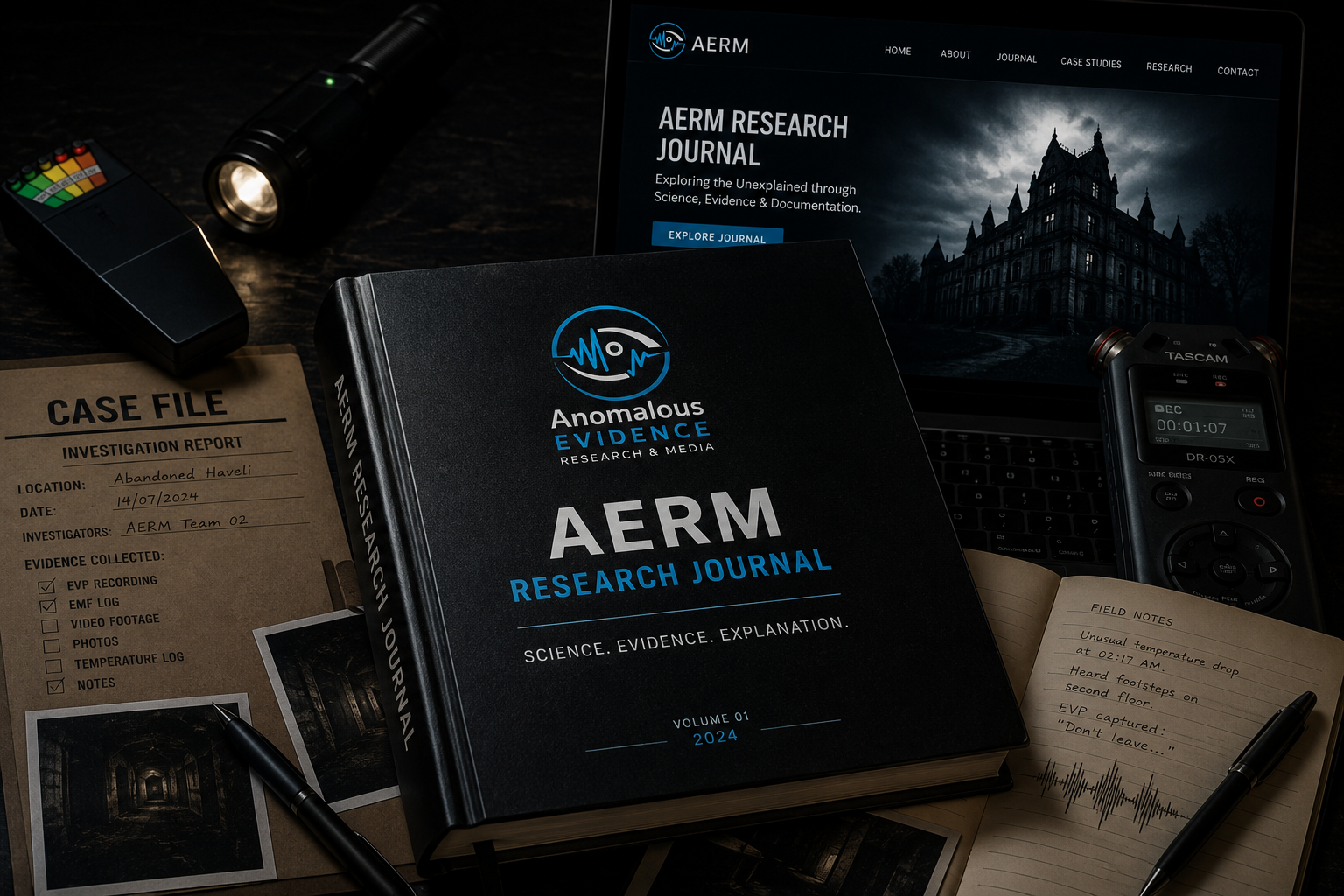
Phantom Voices: How Echoes, Reverberation and Background Noise Fool Human Hearing
A quiet corridor. A distant mechanical hum. A recording played back through headphones.
Someone hears a whisper.
They replay the clip. This time, the sound seems to say a name. Another listener hears a short sentence. A third hears nothing recognisable at all.
Experiences like these are often described as phantom voices, unexplained whispers, or electronic voice phenomena (EVP). But before an investigator concludes that a recording contains a voice, an important question needs to be asked:
Could the sound be an ordinary acoustic event that the brain has interpreted as speech?
Human hearing is remarkably good at recognising patterns, especially speech. That ability is useful in everyday life, but it also means that ambiguous sounds can sometimes seem meaningful. Echoes, reverberation, background noise, overlapping sound sources, and expectations can all influence what a listener believes they heard.
This article explores the science behind these effects and presents a practical method for evaluating alleged phantom voices without dismissing witnesses or overstating what a recording proves.
1. Why Do We Hear Voices in Ambiguous Sounds?
The human auditory system does more than detect sound waves. It organises incoming information, separates sound sources, identifies patterns, and uses context to help interpret what is being heard.
Speech recognition is especially important. In ordinary environments, the brain must identify words even when a speaker is distant, partly masked by traffic, or speaking in a noisy room.
However, when a sound is unclear, the listener may perceive a familiar pattern that is not objectively present. A rustling noise may resemble a whisper. A short mechanical squeak may sound like a syllable. Random fluctuations in static may appear to form a word.
One related concept is auditory pareidolia: perceiving a familiar or meaningful sound pattern, such as speech, in an ambiguous or non-speech signal.
Pareidolia does not mean that the listener is lying or deliberately imagining something. The perception can feel immediate and convincing. It means that the brain's pattern-recognition processes may have assigned a familiar interpretation to uncertain sound information.
The role of expectation
What a listener expects to hear can influence what they notice.
If someone is told that a recording contains the words “get out,” they may be more likely to hear that phrase during playback. A listener who receives no suggested phrase may describe the same sound differently.
This is one reason audio analysis should begin with an unprompted listening record. Investigators should document what they hear before sharing proposed interpretations with other team members.
2. The Difference Between an Echo and Reverberation
Echo and reverberation are related acoustic effects, but they are not identical.
Echo
An echo is a reflection of sound that arrives sufficiently separated in time from the original sound to be perceived as a distinct repetition.
For example, a person shouts in a large empty building. The sound travels to a distant wall, reflects, and returns to the listener. If the reflected sound is delayed enough and sufficiently audible, the listener may hear a separate repeat.
The delay depends on the distance travelled by the sound and the speed of sound in the surrounding air.
For a simple reflection from a surface at distance \(d\), the approximate round-trip delay is:
\[ t = \frac{2d}{c} \]
where:
- \(t\) is the time delay in seconds,
- \(d\) is the distance to the reflecting surface in metres,
- \(c\) is the speed of sound in metres per second.
At approximately 20°C, the speed of sound in air is about 343 m/s. This value changes with temperature and atmospheric conditions.
For example, if a sound reflects from a wall 17 metres away:
\[ t = \frac{2 \times 17}{343} \approx 0.099 \text{ seconds} \]
The reflected sound returns after roughly 99 milliseconds. Whether it is perceived as a distinct echo depends on the signal, the room, the listener, and other reflections.
Reverberation
Reverberation is the persistence of sound in an enclosed or partly enclosed space because sound energy continues to reflect from walls, ceilings, floors, and objects after the original source stops.
Instead of hearing one clear repeat, the listener hears many reflections arriving close together. These reflections overlap and gradually decay.
A room with hard surfaces such as concrete, stone, glass, or tile may produce stronger and longer-lasting reflections than a room containing thick curtains, carpets, upholstered furniture, and other sound-absorbing materials.
Reverberation can blur speech. Consonants may become less distinct, syllables may overlap, and distant sounds may become difficult to identify.
In an old building with long corridors, stairwells, high ceilings, or connected rooms, reflections can make it difficult to determine where a sound originated.
3. How Room Acoustics Can Make Ordinary Sounds Seem Unusual
A building does not need to be haunted to produce confusing sounds. Its geometry and materials can significantly affect what a person hears.
3.1 Hard surfaces
Stone, concrete, tile, glass, and plaster can reflect a substantial amount of sound energy. In a sparsely furnished room, reflections may persist longer than they would in a room with soft furnishings.
A small sound from outside the room may be reflected and distributed in a way that makes its direction difficult to identify.
3.2 Long corridors and staircases
Long corridors can create repeated reflections between parallel surfaces. Stairwells can connect multiple floors acoustically, allowing sounds to travel between locations.
A voice from another floor may appear to come from a nearby doorway. Footsteps may seem closer or farther away than they really are.
3.3 Doorways and connected spaces
An open doorway can allow sound from another room to enter. The sound may be partly blocked, filtered, or reflected before reaching the listener.
A person may hear only a small portion of a conversation. Without the surrounding context, that fragment can resemble a whisper or an unfamiliar voice.
3.4 Building services and mechanical noise
Fans, pumps, pipes, lifts, electrical equipment, and ventilation systems can produce tonal, intermittent, or fluctuating sounds.
When these sounds interact with room resonances or other noise sources, they may create patterns that resemble speech to some listeners.
These possibilities should be examined rather than assumed. A mechanical source is a hypothesis to test, not an automatic explanation for every unusual recording.
4. Background Noise: The Sound Beneath the Sound
Background noise is any unwanted or secondary sound present alongside the sound an investigator is trying to record.
In a supposedly quiet building, background noise may include:
- Air-conditioning and ventilation.
- Electrical transformers and power supplies.
- Fans, refrigerators, and pumps.
- Traffic and aircraft.
- Wind passing through gaps or openings.
- Insects, birds, and other animals.
- Water moving through pipes.
- Clothing movement, handling noise, and footsteps.
- Microphone self-noise and electronic interference.
Some noise is continuous; other noise appears in short bursts.
Signal-to-noise ratio
The signal-to-noise ratio (SNR) describes the level of a desired signal relative to the background noise.
It is commonly expressed in decibels:
\[ SNR = L_{\text{signal}} - L_{\text{noise}} \]
where the levels are measured using compatible methods and conditions.
A higher SNR generally makes the desired sound easier to distinguish from background noise. A low SNR makes interpretation more difficult.
For example, a quiet voice recorded near a running fan may be masked by the fan. A listener may then try to interpret fragments of the remaining sound as words.
It is important not to confuse a higher recording volume with a better SNR. Increasing the volume raises both the wanted signal and the recorded noise. It does not necessarily reveal additional information.
5. Auditory Masking and the Missing-Word Problem
Auditory masking occurs when one sound makes another sound harder to hear.
A loud vehicle may mask a quiet conversation. A ventilation fan may cover low-level speech. A sudden impact may obscure the beginning or end of a spoken phrase.
Masking can remove important speech cues. The listener may hear a few surviving fragments and unconsciously fill in the missing parts.
This matters when evaluating alleged whispers. A recording might contain:
- A faint sound at the beginning of a clip.
- A noisy middle section.
- A short high-frequency transient.
- A reverberant tail after the original sound.
- Several overlapping sources.
If a listener expects a sentence, the surviving fragments may seem to fit that sentence even when the recording does not contain enough information to establish the words.
An investigator should therefore distinguish between:
- Audible signal: what is physically present in the recording.
- Perceived speech: what a listener believes the sound resembles.
- Transcription: the words the listener assigns to the sound.
- Verified source: evidence identifying who or what produced it.
These are separate claims and require different levels of support.
6. Why Repeated Listening Can Change What We Hear
Repeated playback is common in audio investigation. It can help identify details that were missed on the first listen, but it can also strengthen an expectation.
Suppose an investigator hears an unclear sound and suggests that it says “help me.” Other team members listen to the same clip after hearing that suggestion. They may begin to hear the same phrase.
This does not establish that the phrase is present. The listeners have been given a possible interpretation before making an independent judgement.
A stronger process is:
- Preserve the original recording.
- Ask listeners to review it independently.
- Do not provide a suggested phrase before their first listen.
- Ask each listener to write down what they hear, including “no intelligible speech.”
- Compare the independent descriptions only after they are recorded.
- Record how many people heard a similar phrase without being prompted.
Agreement is more informative when listeners have not influenced one another. Even then, agreement alone does not prove that a voice or external speaker was present.
7. Can Audio Processing Reveal a Hidden Voice?
Audio software can help investigators examine a recording. It can display waveforms, frequency content, amplitude changes, and time-based patterns.
Common tools include:
- Audacity: audio editing, waveform inspection, spectrograms, and basic filtering.
- Sonic Visualiser: detailed visual analysis of audio and spectral features.
- Praat: speech and phonetic analysis.
- FFmpeg: audio conversion, extraction, and technical processing.
- A calibrated sound level meter or measurement microphone: environmental sound measurements, where suitable for the task.
However, processing has limits.
Filtering
A high-pass filter reduces frequencies below a selected cutoff. A low-pass filter reduces frequencies above a selected cutoff. Band-pass filtering retains a selected frequency range.
Filtering may make a particular feature easier to inspect, but it can also remove information or emphasise noise.
Amplification and normalisation
Increasing the level can make quiet portions easier to hear. It also makes background noise more prominent.
Normalisation changes the overall level according to a chosen target. It does not create new acoustic information.
Noise reduction
Noise-reduction algorithms estimate and suppress selected noise components. If the noise resembles parts of speech, the algorithm may also alter speech-like details.
Spectrograms
A spectrogram shows how the frequency content of a signal changes over time. It can help identify tonal components, transients, harmonics, and other acoustic patterns.
A spectrogram does not independently identify a ghost, a speaker, or the meaning of a sound. It is a visual representation of recorded acoustic energy. Interpretation still requires context and careful analysis.
Important principle: A sound that appears more voice-like after aggressive processing is not automatically stronger evidence. The investigator must retain the original file and document every processing step.
8. A Practical AERM Method for Investigating Alleged Phantom Voices
The following workflow is designed to improve documentation and reduce suggestion. It is not a method for proving paranormal activity.
Step 1: Preserve the original recording
Keep the original file unchanged. Do not overwrite it with an edited or enhanced version.
Record:
- File name and format.
- Recording date and time.
- Recording device and microphone.
- Sample rate and bit depth, if known.
- Recording location and microphone position.
- Device settings and any automatic processing.
- Who handled the equipment.
If the recording was transferred between devices, document that too.
Step 2: Record the environment
Document the room and the conditions during the recording:
- Room dimensions and layout, if available.
- Door and window positions.
- Surface materials and furnishings.
- Nearby roads, machinery, ventilation, and electrical equipment.
- Weather conditions where relevant.
- People or animals present.
- Any known activity in adjacent rooms or floors.
Do not assume that a room was silent simply because the team did not consciously notice background noise.
Step 3: Make an unprompted listening record
Before discussing a possible phrase, ask each reviewer to listen independently.
Use a neutral form:
| Field | Record | |---|---| | Reviewer ID | Anonymous reviewer code | | First impression | Their own description | | Perceived words | Exact words, if any | | Confidence | Their own stated confidence | | Alternative interpretation | Other possible sound descriptions | | Intelligibility | Clear speech, uncertain speech, or no intelligible speech |
Avoid asking, “Can you hear the voice saying this?” before the first independent listen.
Step 4: Identify possible ordinary sources
Check for:
- Distant speech or television.
- Wind and airflow.
- Fans and motors.
- Pipe and plumbing noise.
- Animals and insects.
- Footsteps and handling noise.
- Reflections from nearby surfaces.
- Radio-frequency or electrical interference affecting the recording chain.
Where possible, reproduce or record suspected sources under comparable conditions. A similar sound may support a possible explanation, but it does not prove that the original event had the same source.
Step 5: Analyse the recording without altering the master
Create working copies for analysis. Use a consistent workflow:
- Listen to the original file at its original playback speed.
- Note the time interval of interest.
- Inspect the waveform.
- Inspect the spectrogram.
- Apply only documented processing to a copy.
- Compare processed versions with the original.
- Record which details were audible before and after processing.
Do not repeatedly adjust filters until a desired word appears. That approach risks selecting an interpretation from noise.
Step 6: Test the interpretation
If a phrase is proposed, ask:
- Can listeners identify the same words without being told what to hear?
- Is the sound intelligible at normal playback speed?
- Does the phrase remain plausible when played in its full context?
- Could it be explained by a known sound source?
- Does the recording contain enough information to distinguish speech from noise?
- Is there independent evidence identifying a speaker or source?
If the words cannot be reliably identified, describe the sound as ambiguous rather than presenting a speculative transcription as fact.
Step 7: Report limitations
State whether the recording was noisy, heavily processed, clipped, distorted, or captured with unknown equipment settings.
If the source cannot be identified, say so. “Unidentified sound” is a valid result. It is not equivalent to “paranormal voice.”
9. A Controlled Experiment: How Expectations Affect Voice Identification
AERM can demonstrate the influence of expectation using a safe, non-deceptive listening exercise. This is an educational demonstration, not a clinical or formal scientific study.
Objective: Examine whether different listeners independently assign similar words to an ambiguous sound.
Materials:
- A short recording of a non-speech sound, such as airflow, a distant mechanical hum, or a naturally occurring reverberant noise.
- Headphones or speakers at a comfortable volume.
- A group of volunteer listeners.
- Separate response sheets or forms.
- A record of the original audio file.
Procedure:
- Explain that participants will hear a short sound and should describe it honestly.
- Play the unmodified recording once without suggesting that it contains a voice.
- Ask participants to write down what they heard, including uncertainty or no intelligible speech.
- Collect the responses before group discussion.
- If appropriate, conduct a second listening round in which a possible phrase is presented as one interpretation, not as the correct answer.
- Compare the first and second responses.
- Record the method, participant count, playback conditions, and limitations.
Interpretation:
If listeners produce different descriptions initially but converge after being given a suggested phrase, this illustrates how expectation can influence interpretation.
It does not prove that all EVP reports are caused by suggestion. It demonstrates one factor that should be controlled when evaluating ambiguous audio.
Do not use frightening claims, false health warnings, or distressing material in this exercise. Participants should be free to stop at any time.
10. Common Mistakes in EVP and Phantom-Voice Analysis
| Mistake | Why it is a problem | Better practice | |---|---|---| | Telling listeners the phrase first | Encourages expectation and confirmation bias | Collect independent first impressions | | Using only an edited clip | Removes context and may conceal processing effects | Preserve and review the full original | | Excessive amplification | Makes noise more prominent without improving SNR | Report levels and compare with the original | | Aggressive filtering | Can create or exaggerate speech-like artefacts | Use restrained, documented processing | | Treating a spectrogram as proof of speech | Visual patterns do not identify a speaker or source | Combine visual inspection with listening and context | | Ignoring the building | Overlooks reflections, machinery, and distant sound sources | Conduct an environmental acoustic survey | | Reporting guesses as quotations | Makes uncertain interpretations look definite | Label uncertain words and alternative readings | | Repeatedly replaying until a phrase appears | Increases the risk of confirmation bias | Set a review protocol in advance |
11. What Can and Cannot Be Concluded From a Recording?
An audio recording can establish that a microphone captured a particular signal, subject to the integrity and provenance of the file.
With suitable equipment and documentation, investigators may be able to describe:
- The timing and duration of a sound.
- Its approximate frequency content.
- Its amplitude relative to other recorded sounds.
- Whether it contains features consistent with speech.
- Whether it resembles a known environmental source.
- Whether multiple recordings captured a similar event.
A recording alone may not establish:
- The identity of a speaker.
- The intention behind a sound.
- The exact location of the source.
- Whether a voice was human, animal, mechanical, or otherwise generated.
- Whether an unexplained sound has a paranormal origin.
The strength of a conclusion depends on recording quality, provenance, repeatability, independent review, and the availability of alternative explanations.
12. AERM Research Perspective
At AERM, audio evidence should be treated as recorded data—not as a story that the investigator must complete.
A faint sound may resemble a voice. A corridor may produce complex reflections. A fan may mask part of a conversation. A listener may hear a phrase after someone suggests what it is supposed to say.
Each of these possibilities can be examined systematically.
AERM's approach is to preserve original recordings, document the acoustic environment, collect independent listening reports, use processing transparently, and distinguish an audible signal from an interpretation of that signal.
No anomaly is considered paranormal until environmental, psychological, technical, and scientific explanations have been systematically evaluated.
An unidentified sound is not a failed investigation. It is an accurate description of the evidence when the source has not yet been established.
Conclusion
Phantom voices are compelling because speech is one of the most familiar patterns the human brain recognises. In a reverberant building or noisy environment, fragments of sound can be blurred, masked, repeated, or distorted. The brain may interpret these fragments as words, especially when a listener expects to hear a voice.
Echoes and reverberation can change the way a sound reaches the ear. Background noise can hide important details. Repeated listening and suggested phrases can influence what people believe they hear. Audio software can help examine a recording, but processing cannot independently establish the source or meaning of an ambiguous sound.
For investigators, the best approach is disciplined and transparent: preserve the original, document the environment, listen independently, avoid leading questions, test ordinary sources, and report uncertainty honestly.
The goal is not to make every strange sound disappear—or to turn every unclear noise into a voice. The goal is to find out what the recording can genuinely tell us.
---
References and Further Reading
The following sources provide foundations for room acoustics, auditory perception, speech intelligibility, and auditory scene analysis. Check the relevant edition and publication details before using these references in formal academic work.
- Blauert, J. (1997). Spatial Hearing: The Psychophysics of Human Sound Localization (revised edition). MIT Press.
- Bregman, A. S. (1990). Auditory Scene Analysis: The Perceptual Organization of Sound. MIT Press.
- Howard, D. M., & Angus, J. (2017). Acoustics and Psychoacoustics (5th edition). Routledge.
- International Organization for Standardization. (2009). ISO 3382-1:2009 Acoustics—Measurement of Room Acoustic Parameters—Part 1: Performance Spaces. ISO.
- International Organization for Standardization. (2008). ISO 3382-2:2008 Acoustics—Measurement of Room Acoustic Parameters—Part 2: Reverberation Time in Ordinary Rooms. ISO.
- Moore, B. C. J. (2012). An Introduction to the Psychology of Hearing (6th edition). Brill.
- Rosen, S., & Howell, P. (2011). Signals and Systems for Speech and Hearing (2nd edition). Brill.
About AERM
Anomalous Evidence Research & Media (AERM) is an independent research and media initiative focused on the systematic documentation and evaluation of unusual reports. Its approach combines environmental assessment, witness documentation, scientific reasoning, and evidence analysis.
AERM does not treat an unusual experience or unexplained recording as proof of a paranormal cause. Each report should be evaluated against plausible environmental, perceptual, psychological, and technical explanations.
Educational disclaimer: This article is for general educational and research-awareness purposes. It is not medical, forensic, or engineering advice. Do not enter unsafe or restricted buildings to make recordings. Obtain permission, follow site safety procedures, and use appropriate hearing levels when reviewing audio.