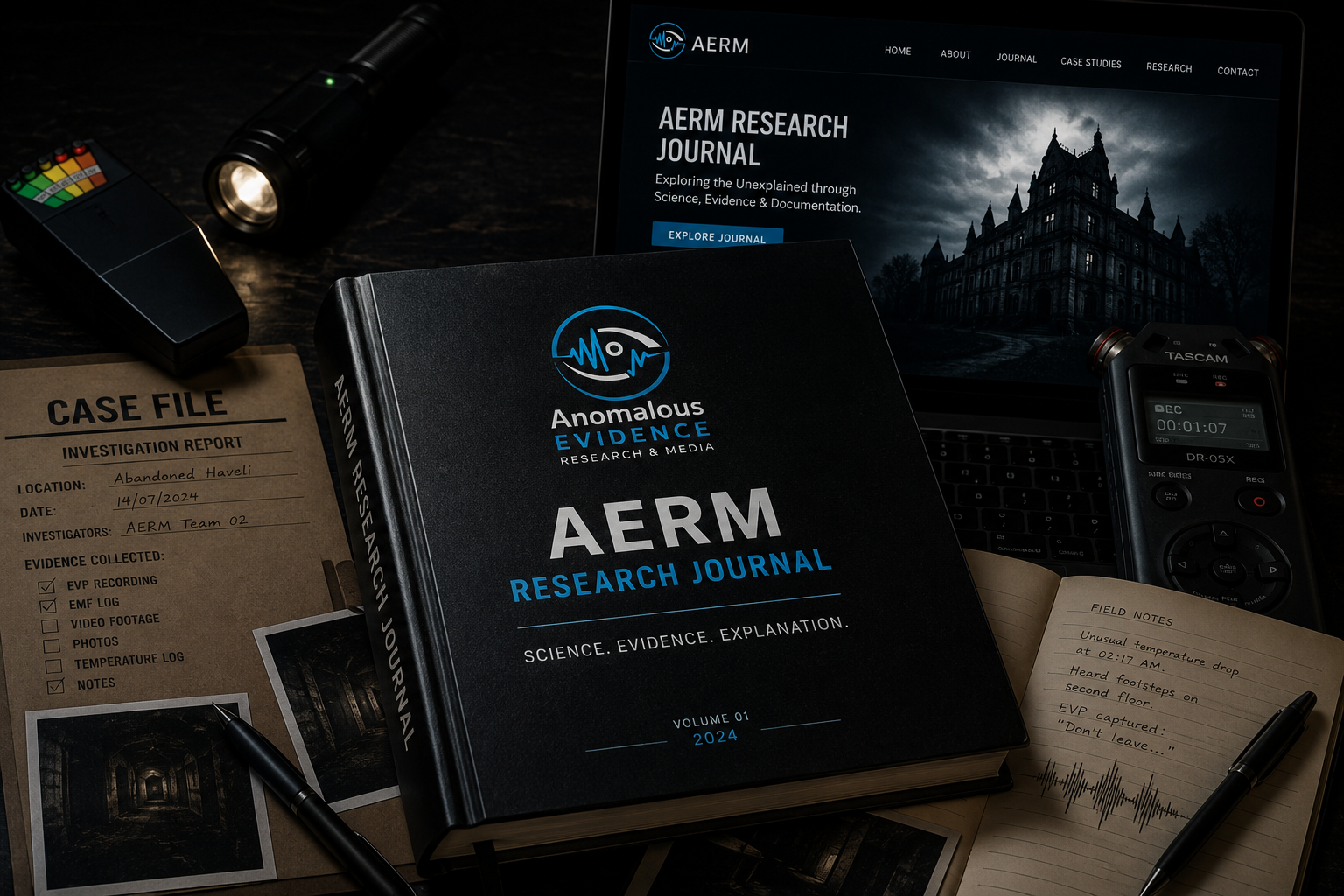
Why Evidence Matters More Than Belief: An Editorial on Responsible Investigation
Beliefs may inspire questions, but only evidence can support answers.
The study of unexplained phenomena has always attracted curiosity. Throughout history, people have attempted to understand unusual experiences through religion, folklore, personal beliefs, cultural traditions, and, more recently, scientific inquiry.
Curiosity is valuable.
It motivates exploration, encourages learning, and inspires investigation.
However, curiosity alone is not enough.
Without evidence, curiosity can become assumption. Assumptions can become certainty. And certainty without evidence can prevent us from discovering what is actually true.
At Anomalous Evidence Research & Media (AERM), we believe that evidence—not belief—should remain the foundation of every investigation.
---
Curiosity Begins the Journey
Every scientific discovery began with a question.
Why did this happen?
Can it be measured?
Can it be repeated?
Is there another explanation?
Questions are not signs of ignorance.
They are the beginning of knowledge.
Responsible investigators never lose their curiosity, but they also recognize that curiosity must be guided by disciplined methodology and objective observation.
---
Belief Is Personal. Evidence Is Universal.
Beliefs differ from person to person.
Evidence does not.
Two investigators may approach the same location with completely different expectations.
One may expect paranormal activity.
Another may expect environmental causes.
If both investigators follow the same methodology, collect the same measurements, and analyze the same evidence objectively, their conclusions should depend on the evidence—not their expectations.
That is what makes evidence valuable.
It creates a common foundation for discussion, regardless of personal beliefs.
---
Uncertainty Is Not Failure
One of the greatest misconceptions in investigation is the idea that every question must have an immediate answer.
Sometimes the evidence is sufficient to explain an event.
Sometimes it supports multiple possibilities.
Sometimes it is simply incomplete.
There is nothing unscientific about saying:
"We do not yet know."
Accepting uncertainty demonstrates intellectual honesty.
Forcing certainty where evidence is lacking does the opposite.
---
Extraordinary Claims Require Extraordinary Care
Reports of unexplained experiences deserve careful attention.
They also deserve careful evaluation.
Extraordinary claims should never be dismissed without investigation.
Equally, they should never be accepted without evidence.
Responsible investigation requires patience, documentation, environmental analysis, and a willingness to challenge our own assumptions.
The goal is not to prove or disprove extraordinary claims.
The goal is to understand them.
---
The Responsibility of Public Communication
Investigators have responsibilities beyond the field.
The way research is communicated shapes public understanding.
Exaggerated headlines, selective reporting, and unsupported conclusions may attract attention, but they also create misunderstanding.
Professional communication requires:
- Accuracy
- Transparency
- Context
- Humility
- Accountability
Public trust is earned through consistency—not sensationalism.
---
Technology Is a Tool, Not an Answer
Modern investigations benefit from sophisticated equipment.
Environmental sensors, thermal imaging, digital photography, and data logging have improved our ability to document observations.
However, technology does not eliminate the need for critical thinking.
A measurement is only meaningful when it is interpreted within its proper context.
Instruments collect data.
Investigators interpret data.
Evidence supports conclusions.
---
Learning Means Changing
One hallmark of scientific thinking is the willingness to revise conclusions when new evidence becomes available.
Changing one's conclusion in light of better evidence is not inconsistency.
It is progress.
Every investigation should leave room for learning.
Every conclusion should remain open to re-evaluation if new information emerges.
Knowledge grows because investigators remain willing to ask difficult questions—even of their own work.
---
Respect Matters
Every report received by an investigator represents a real experience for someone.
Regardless of whether an event ultimately has an environmental explanation, remains inconclusive, or cannot currently be explained, witnesses deserve to be treated with professionalism and respect.
Respecting people does not require abandoning objectivity.
Likewise, remaining objective does not require dismissing personal experiences.
Professional investigation balances empathy with evidence.
---
AERM's Perspective
AERM does not begin investigations with predetermined answers.
We begin with observations.
We document carefully.
We measure consistently.
We analyze critically.
We report honestly.
Our objective is not to defend a particular worldview but to contribute reliable, transparent, and evidence-based research that others can evaluate independently.
---
Looking Forward
The future of paranormal investigation should be shaped not by louder claims, but by better research.
As technology improves and scientific understanding expands, investigators have an opportunity to raise professional standards through stronger methodology, better documentation, ethical conduct, and open collaboration.
Progress depends not on believing more—but on investigating better.
---
Conclusion
Belief may motivate investigation, but it should never determine its outcome.
Evidence remains the most reliable guide available to investigators because it can be observed, measured, documented, and independently evaluated.
At AERM, we believe that responsible investigation begins with curiosity, is strengthened by methodology, and ultimately depends on the integrity of the evidence collected.
Whatever conclusions the evidence supports, those are the conclusions we should be willing to accept.
Evidence should never be shaped to fit belief. Beliefs should always remain open to evidence.
---
Editor's Note
Editorial articles published by AERM reflect the organization's commitment to evidence-based investigation, scientific curiosity, and responsible public communication. They are intended to encourage thoughtful discussion about investigative practices and the evolving relationship between science, observation, and unexplained reports.
---
About AERM
Anomalous Evidence Research & Media (AERM) is an independent research organization dedicated to investigating unexplained reports through scientific methodology, environmental analysis, critical evaluation, and transparent documentation. Our mission is to promote responsible investigation, public education, and evidence-based research.
---
Disclaimer
This editorial expresses AERM's organizational philosophy regarding evidence-based investigation. It does not advocate for or against any particular belief system. Readers are encouraged to evaluate all claims—ordinary or extraordinary—through careful observation, critical thinking, and reliable evidence.