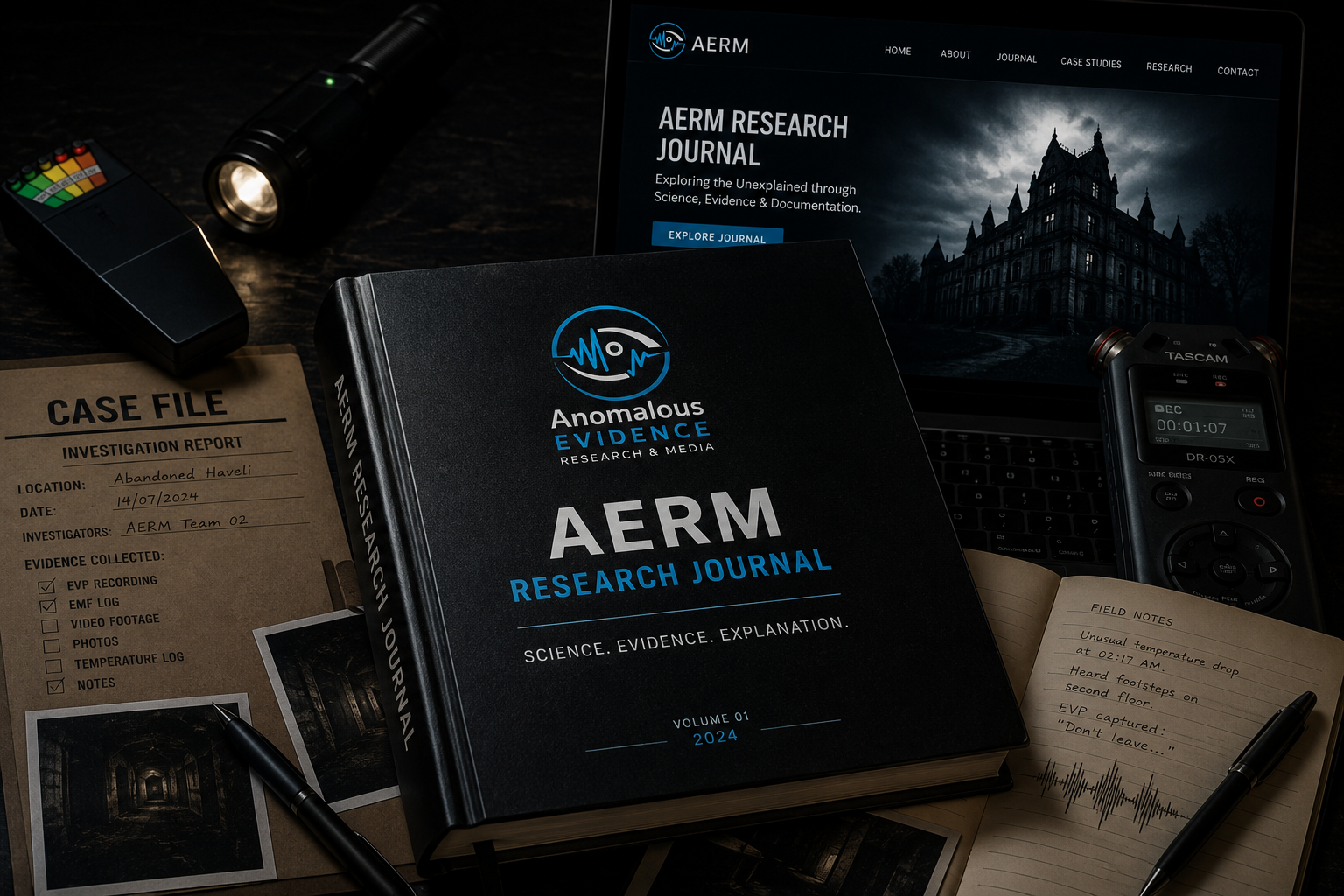
The History of Paranormal Investigation: From Folklore to Scientific Inquiry
The desire to understand the unexplained is as old as human civilization. What has changed over time is the way we investigate it.
Across cultures and throughout history, people have reported experiences they believed could not be explained through ordinary means. Stories of apparitions, mysterious sounds, unexplained lights, and unusual locations appear in nearly every civilization.
While early societies often interpreted these experiences through religion, mythology, or folklore, the methods used to investigate such claims have evolved significantly. Today, responsible investigations increasingly rely on observation, environmental measurement, documentation, and critical analysis rather than assumption.
This article explores how paranormal investigation developed over thousands of years and why modern methodology emphasizes evidence over belief.
---
Executive Summary
The study of unexplained phenomena has progressed through several historical stages:
- Ancient folklore and mythology
- Religious and spiritual interpretations
- Early scientific curiosity
- Organized psychical research
- Technological investigation
- Modern evidence-based methodology
Each stage reflects humanity's continuing effort to understand unusual experiences using the knowledge and tools available at the time.
---
Ancient Civilizations
Long before written science existed, unusual experiences were often interpreted through mythology and religious beliefs.
Ancient civilizations, including those of Egypt, Mesopotamia, India, China, Greece, and Rome, recorded accounts of:
- Apparitions
- Dreams
- Omens
- Sacred locations
- Ritual experiences
- Unusual natural phenomena
These accounts became part of cultural traditions and shaped how societies understood unexplained events.
Although these records are historically valuable, they generally lack the systematic documentation expected in modern investigations.
---
The Medieval Period
During the medieval era, many unexplained events were interpreted through religious doctrine.
Reports involving strange sounds, apparitions, or unusual experiences were frequently associated with:
- Divine intervention
- Spiritual beliefs
- Demonic influence
- Religious miracles
Documentation from this period was often theological rather than investigative, focusing on belief rather than environmental analysis.
---
The Age of Enlightenment
The scientific revolution encouraged observation, experimentation, and critical thinking.
Rather than accepting extraordinary claims without question, scholars increasingly asked:
- Can this observation be measured?
- Can it be repeated?
- Is there a natural explanation?
- What evidence supports the claim?
These questions laid the foundation for modern scientific investigation.
---
The Rise of Psychical Research
During the late nineteenth century, researchers began examining reports of unusual experiences using more structured methods.
Organizations dedicated to psychical research attempted to document claims systematically through:
- Witness interviews
- Controlled observation
- Written records
- Experimental procedures
Although many early investigations lacked modern technology, they represented an important shift toward evidence-based inquiry
---
Technological Advancements
The twentieth century introduced tools that transformed investigative practice.
Investigators gradually adopted equipment such as:
- Cameras
- Audio recorders
- Video systems
- Environmental sensors
- Thermal imaging
- Electromagnetic field meters
- Digital documentation systems
These technologies improved documentation but did not eliminate the need for careful interpretation.
Technology records data—it does not automatically explain it.
---
The Modern Scientific Approach
Today, professional investigations increasingly emphasize environmental science and structured methodology.
Modern investigations typically include:
- Site assessment
- Environmental measurements
- Evidence documentation
- Comparative analysis
- Alternative explanation assessment
- Transparent reporting
Rather than attempting to prove extraordinary claims, investigators seek to understand what the available evidence objectively demonstrates.
---
The Role of Environmental Science
Research has shown that many reported experiences can be influenced by environmental conditions.
Examples include:
- Lighting variations
- Temperature differences
- Air movement
- Acoustic reflections
- Structural movement
- Electrical interference
- Wildlife activity
Understanding these variables allows investigators to distinguish measurable environmental influences from observations requiring further study.
---
Lessons from History
Historical investigations demonstrate that methods evolve as knowledge and technology improve.
Several important lessons remain relevant today:
- Documentation is more valuable than speculation.
- Extraordinary claims require careful evaluation.
- Technology supports investigation but does not replace critical thinking.
- Transparency strengthens credibility.
- Scientific progress depends on questioning assumptions.
History reminds investigators that methodology matters as much as curiosity.
---
The Future of Paranormal Investigation
Emerging technologies continue to improve environmental monitoring and documentation.
Future investigations may benefit from:
- Artificial intelligence for data analysis
- High-resolution environmental sensors
- Advanced thermal imaging
- Three-dimensional mapping
- Automated environmental monitoring
- Improved digital evidence management
However, regardless of technological advances, careful observation and objective analysis will remain essential.
---
AERM's Perspective
AERM views paranormal investigation as an interdisciplinary field that benefits from environmental science, psychology, engineering, photography, acoustics, and critical thinking.
Our objective is not to confirm extraordinary beliefs but to investigate unusual reports through transparent methodology and evidence-based evaluation.
By combining historical understanding with modern scientific practices, investigators can produce research that is both responsible and credible.
---
Conclusion
The history of paranormal investigation reflects humanity's enduring curiosity about experiences that challenge conventional understanding.
From ancient folklore to modern environmental analysis, the investigative journey has evolved from storytelling toward systematic inquiry.
While many questions remain unanswered, the pursuit of knowledge is strengthened by careful observation, rigorous methodology, and a commitment to following evidence wherever it leads.
History teaches us that curiosity begins an investigation, but methodology determines its value.
---
Timeline of Paranormal Investigation
| Period | Primary Approach | |---------|------------------| | Ancient Civilizations | Mythology, oral traditions, spiritual beliefs | | Medieval Era | Religious interpretation | | Age of Enlightenment | Observation and scientific questioning | | 19th Century | Organized psychical research | | 20th Century | Technological documentation | | 21st Century | Environmental science, digital evidence, multidisciplinary analysis |
---
References
This article is based on historical developments in scientific inquiry, environmental research, the history of psychical research, and modern investigative methodology. Readers are encouraged to explore academic literature on the history of science, psychology, folklore studies, and evidence-based investigation for additional perspectives.
---
About AERM
Anomalous Evidence Research & Media (AERM) is an independent research organization dedicated to investigating unexplained reports through scientific methodology, environmental analysis, critical evaluation, and transparent documentation.
---
Disclaimer
This article is intended for educational purposes and provides a historical overview of how the investigation of unexplained phenomena has evolved over time. It should not be interpreted as evidence supporting or refuting any specific paranormal claim. AERM encourages critical thinking, objective analysis, and responsible research in all investigations.