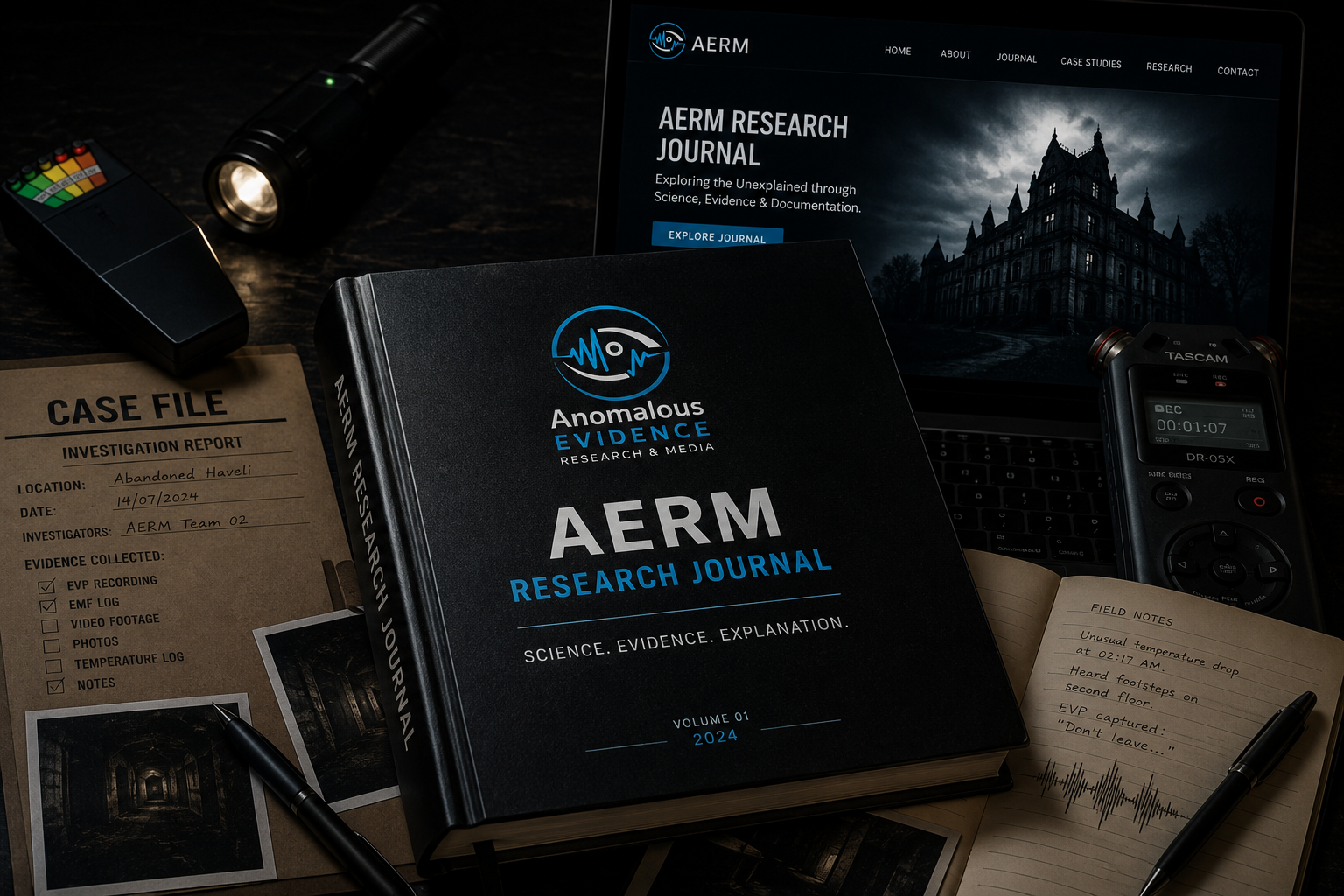
Environmental Noise and Paranormal Perception: Understanding the Science Behind Unexplained Sounds
Not every unexplained sound is extraordinary. Understanding the environment is the first step toward understanding the experience.
Reports of unexplained footsteps, whispers, knocks, voices, and other mysterious sounds are among the most common reasons people seek paranormal investigations. While such experiences can be unsettling, environmental acoustics often provide natural explanations that are not immediately obvious.
At Anomalous Evidence Research & Media (AERM), audio observations are never evaluated in isolation. Instead, they are analyzed alongside environmental conditions, building characteristics, weather, and other measurable variables to ensure conclusions remain grounded in evidence rather than assumption.
---
Executive Summary
Environmental noise analysis helps investigators:
- Identify natural sound sources.
- Understand acoustic behavior within structures.
- Differentiate between environmental and unexplained sounds.
- Improve evidence reliability.
- Reduce misinterpretation caused by human perception.
Every unexplained sound deserves careful investigation before extraordinary conclusions are considered.
---
What Is Environmental Noise?
Environmental noise refers to all sounds present within an environment, whether they originate naturally or from human activity.
Common sources include:
- Wind
- Rain
- Wildlife
- Insects
- Traffic
- Aircraft
- Nearby conversations
- Mechanical equipment
- HVAC systems
- Plumbing
- Electrical transformers
- Building expansion and contraction
Many of these sounds may be subtle, intermittent, or amplified by environmental conditions.
---
Why Sound Can Be Misinterpreted
Human hearing is highly sensitive, particularly in unfamiliar or low-light environments.
Factors influencing perception include:
- Stress
- Fatigue
- Expectation
- Reduced visibility
- Echoes
- Reverberation
- Background silence
- Psychological priming
Under these conditions, ordinary sounds may appear louder, closer, or more unusual than they actually are.
---
The Science of Acoustics
Sound travels differently depending on the environment.
Investigators evaluate factors such as:
- Room dimensions
- Surface materials
- Ceiling height
- Doorways
- Hallways
- Empty spaces
- Structural cavities
These characteristics influence how sound reflects, echoes, and propagates through a building.
A sound originating in one room may appear to come from an entirely different location due to acoustic reflections.
---
Common Sources of Unexplained Sounds
During investigations, AERM frequently evaluates:
- Wooden floor movement
- Metal expansion and contraction
- Loose roofing materials
- Water pipes
- Air ducts
- Elevator systems
- Electrical equipment
- Animal activity
- Tree branches
- Weather-related vibrations
Understanding these sources helps investigators rule out environmental causes before considering more unusual possibilities.
---
Audio Documentation
Reliable investigations require systematic recording procedures.
AERM documents:
- Time of occurrence
- Exact location
- Weather conditions
- Building occupancy
- Environmental measurements
- Audio recordings
- Investigator observations
This information creates a timeline that supports later analysis and verification.
---
Environmental Correlation
Audio observations are compared with:
- EMF measurements
- Temperature readings
- Humidity levels
- Air pressure
- Wind conditions
- Structural inspections
- Video recordings
- Witness interviews
A single observation rarely provides sufficient evidence on its own.
Instead, investigators examine how multiple sources of information relate to one another.
---
Best Practices
Professional investigators should:
- Maintain quiet observation periods.
- Record continuous ambient audio.
- Document nearby activities.
- Repeat observations whenever possible.
- Identify known sound sources.
- Preserve original recordings.
- Avoid interpreting sounds during collection.
Separating observation from interpretation improves objectivity.
---
Limitations of Audio Evidence
Audio recordings are valuable but must be interpreted carefully.
Challenges include:
- Background noise
- Microphone sensitivity
- Compression artifacts
- Wind interference
- Echoes
- Electronic interference
- Human interpretation
These limitations highlight the importance of corroborating audio observations with additional environmental data.
---
The Importance of Critical Analysis
Investigators should ask:
- Can the sound be reproduced?
- Is there a nearby environmental source?
- Does the recording match witness observations?
- Were environmental conditions documented?
- Have alternative explanations been considered?
Only after systematic evaluation should conclusions be reached.
---
Conclusion
Environmental acoustics play a significant role in many reports of unexplained sounds.
By combining careful observation, objective measurement, and evidence-based analysis, investigators can better understand the complex relationship between environmental conditions and human perception.
At AERM, unexplained sounds are approached with curiosity, discipline, and scientific responsibility—not assumption
Every sound has a source. The investigator's responsibility is to discover it through evidence, not expectation.
---
References
This article draws upon established principles of acoustics, environmental science, building engineering, audio recording practices, and evidence-based investigative methodology. Readers are encouraged to explore peer-reviewed research in architectural acoustics, psychoacoustics, and environmental noise analysis for further study
---
About AERM
Anomalous Evidence Research & Media (AERM) is an independent research organization dedicated to investigating unexplained reports through scientific methodology, environmental analysis, critical evaluation, and transparent documentation.
---
Disclaimer
This article is intended for educational and research purposes. The presence of unusual sounds does not, by itself, constitute evidence of paranormal activity. Audio observations should always be interpreted alongside environmental measurements, supporting evidence, and established scientific principles.