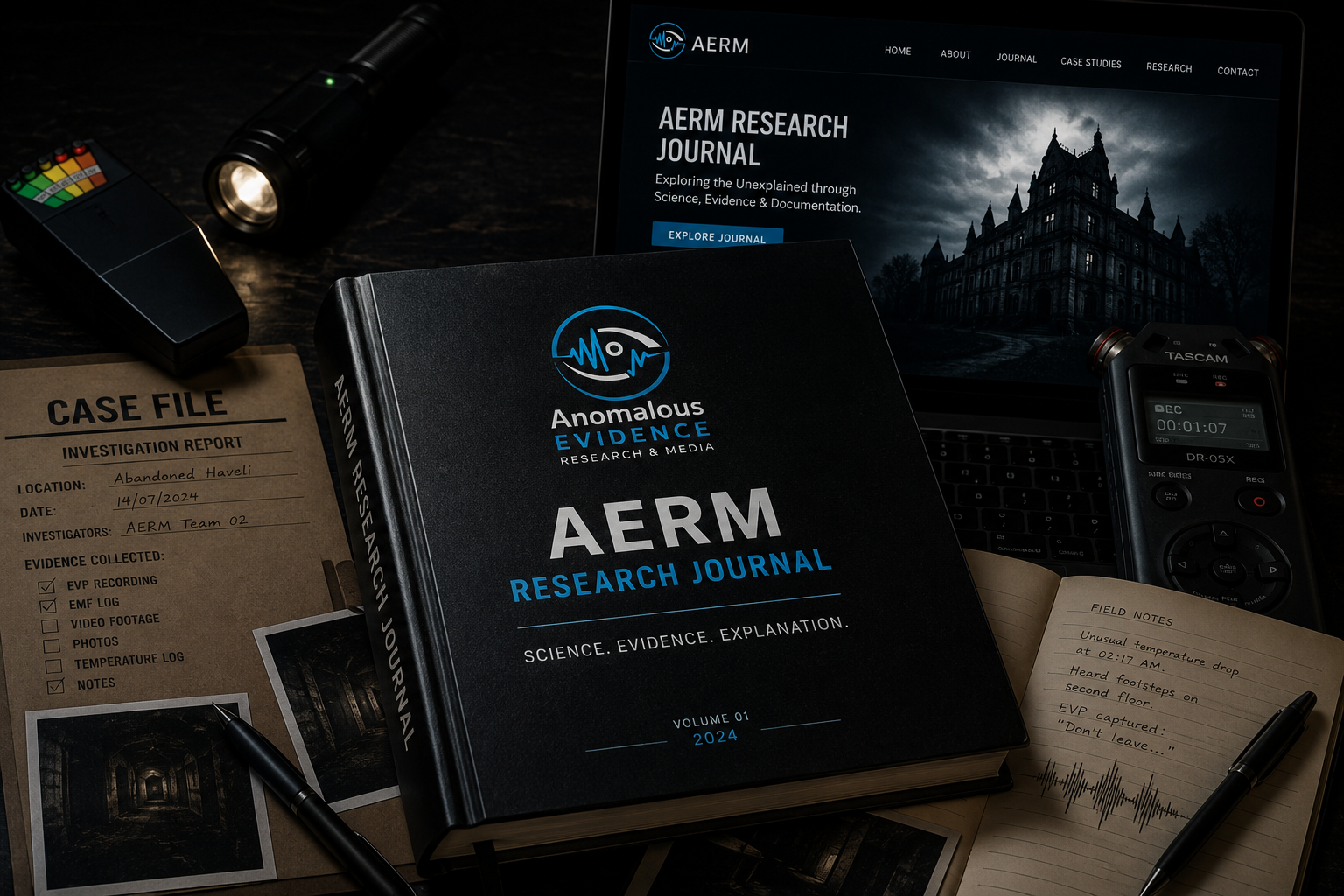
The Role of Forensic Science in Paranormal Investigations: Applying Scientific Principles to Unexplained Reports
Forensic science is not about proving extraordinary claims—it is about preserving facts, protecting evidence, and supporting objective investigation.
When people hear the term forensic science, they often associate it exclusively with criminal investigations. In reality, forensic principles extend far beyond the courtroom. The disciplines of documentation, evidence preservation, scene management, and analytical reasoning can also strengthen investigations involving unexplained reports.
At Anomalous Evidence Research & Media (AERM), forensic principles provide a structured framework for handling information responsibly. Whether investigating unusual environmental observations or reports of unexplained activity, the integrity of the investigation depends on how evidence is collected, preserved, and analyzed.
Applying forensic thinking does not make a paranormal claim more credible. Instead, it ensures that any conclusions are supported by reliable documentation and objective analysis.
---
Executive Summary
Forensic science contributes to investigations by helping teams:
- Preserve evidence integrity.
- Document scenes systematically.
- Reduce contamination.
- Maintain accurate records.
- Support objective analysis.
- Improve transparency and reproducibility.
A disciplined investigative process begins with reliable evidence management.
---
What is Forensic Science?
Forensic science is the application of scientific principles and analytical methods to examine, document, and interpret evidence.
It combines knowledge from multiple disciplines, including:
- Biology
- Chemistry
- Physics
- Environmental Science
- Digital Imaging
- Photography
- Trace Evidence Analysis
- Documentation
- Data Interpretation
The primary objective is not to confirm assumptions but to establish facts through verifiable evidence.
---
Why Forensic Principles Matter
Investigations often involve locations where environmental conditions change rapidly and observations cannot always be repeated.
Without systematic documentation:
- Evidence may be lost.
- Observations may become unreliable.
- Environmental context may disappear.
- Conclusions become difficult to verify.
Applying forensic standards helps preserve the integrity of every investigation.
---
Scene Documentation
Before collecting any evidence, investigators should document the scene exactly as it is found.
Documentation typically includes:
- Overall photographs
- Mid-range photographs
- Close-up photographs
- Video walkthroughs
- Location sketches
- Environmental notes
- Weather conditions
- Lighting conditions
- Time and date records
Accurate documentation creates a permanent record that supports later analysis
---
Evidence Preservation
Evidence should always be preserved in its original condition whenever possible.
Examples include:
- Digital photographs
- Audio recordings
- Video files
- Environmental measurements
- Physical samples
- Written observations
Investigators should avoid altering, enhancing, or manipulating evidence before completing the original documentation process.
---
Preventing Contamination
One of the most important forensic principles is preventing contamination.
Potential sources include:
- Investigators
- Visitors
- Weather
- Equipment
- Animals
- Improper handling
Even unintentional contamination can affect the reliability of collected evidence.
Maintaining scene integrity is therefore essential.
---
Environmental Context
Evidence has little meaning without context.
For every observation, investigators should record:
- Temperature
- Relative humidity
- Atmospheric pressure
- Light intensity
- Electromagnetic field levels
- Background noise
- Airflow
- Weather conditions
Environmental documentation helps explain observations that might otherwise appear unusual.
---
Photography Standards
Photographs should accurately represent the investigation scene.
Best practices include:
- Capture wide-angle views first.
- Record the exact location.
- Avoid excessive editing.
- Preserve original image files.
- Document camera settings where practical.
- Maintain chronological order.
Images should document reality—not create dramatic effects.
---
Digital Evidence Management
Modern investigations rely heavily on digital evidence.
This includes:
- Digital photographs
- Audio recordings
- Video recordings
- Environmental sensor logs
- GPS data
- Metadata
Original files should always be preserved.
Any processed copies should be clearly identified to distinguish them from the original evidence.
---
Witness Documentation
Witness accounts remain valuable but require careful documentation.
Investigators should:
- Record statements accurately.
- Avoid leading questions.
- Separate observations from interpretations.
- Document interview conditions.
- Preserve original interview records.
Witness testimony should complement—not replace—physical and environmental evidence.
---
The Importance of Chain of Custody
Every piece of evidence should have a documented history.
A basic chain of custody records:
- Who collected the evidence.
- When it was collected.
- Where it was collected.
- How it was stored.
- Who accessed it.
- Any transfers or examinations.
Maintaining this record supports transparency and strengthens the credibility of the investigation.
---
Scientific Analysis
Collected evidence should be evaluated using objective methods.
Investigators compare:
- Environmental measurements
- Photographic documentation
- Audio recordings
- Video evidence
- Historical records
- Structural observations
- Witness testimony
No single source should determine the outcome of an investigation.
Reliable conclusions emerge from the convergence of multiple independent observations.
---
Common Mistakes
Investigators should avoid:
- Altering evidence before documentation.
- Ignoring environmental conditions.
- Drawing conclusions too early.
- Failing to preserve original files.
- Mixing observations with interpretations.
- Overlooking alternative explanations.
Careful methodology reduces these risks.
---
Best Practices
Professional investigators should:
- Document first, interpret later.
- Preserve original evidence.
- Record environmental conditions.
- Maintain organized case files.
- Keep detailed investigation logs.
- Review findings independently.
- Clearly communicate limitations.
Consistency strengthens investigative credibility.
---
Conclusion
Forensic science provides valuable principles that improve the quality, transparency, and reliability of investigations into unexplained reports.
By emphasizing documentation, evidence preservation, environmental context, and objective analysis, investigators can produce findings that withstand critical examination and contribute meaningfully to ongoing research.
At AERM, forensic principles are not used to validate extraordinary claims—they are used to ensure that every investigation is conducted with professionalism, integrity, and scientific responsibility.
Reliable investigations begin with reliable evidence. Reliable evidence begins with disciplined documentation.
---
Key Takeaways
- Document every scene before collecting evidence.
- Preserve original files and measurements.
- Prevent contamination whenever possible.
- Maintain a clear chain of custody.
- Consider environmental context.
- Compare multiple sources of evidence.
- Separate facts from interpretations.
- Accept uncertainty when evidence is insufficient.
---
References
The concepts presented in this article are based on internationally recognized principles of forensic science, crime scene documentation, evidence preservation, environmental investigation, scientific methodology, and digital evidence management. Readers are encouraged to consult forensic science textbooks, ISO standards, and peer-reviewed research for further study.
---
About AERM
Anomalous Evidence Research & Media (AERM) is an independent research organization dedicated to investigating unexplained reports through scientific methodology, environmental analysis, forensic documentation, critical evaluation, and transparent reporting.
---
Disclaimer
This article is intended for educational and research purposes. While forensic science provides valuable investigative principles, it should not be interpreted as a method for confirming paranormal claims. AERM applies forensic methodologies to improve evidence quality, documentation standards, and investigative transparency, ensuring that conclusions are based on objective analysis rather than speculation.