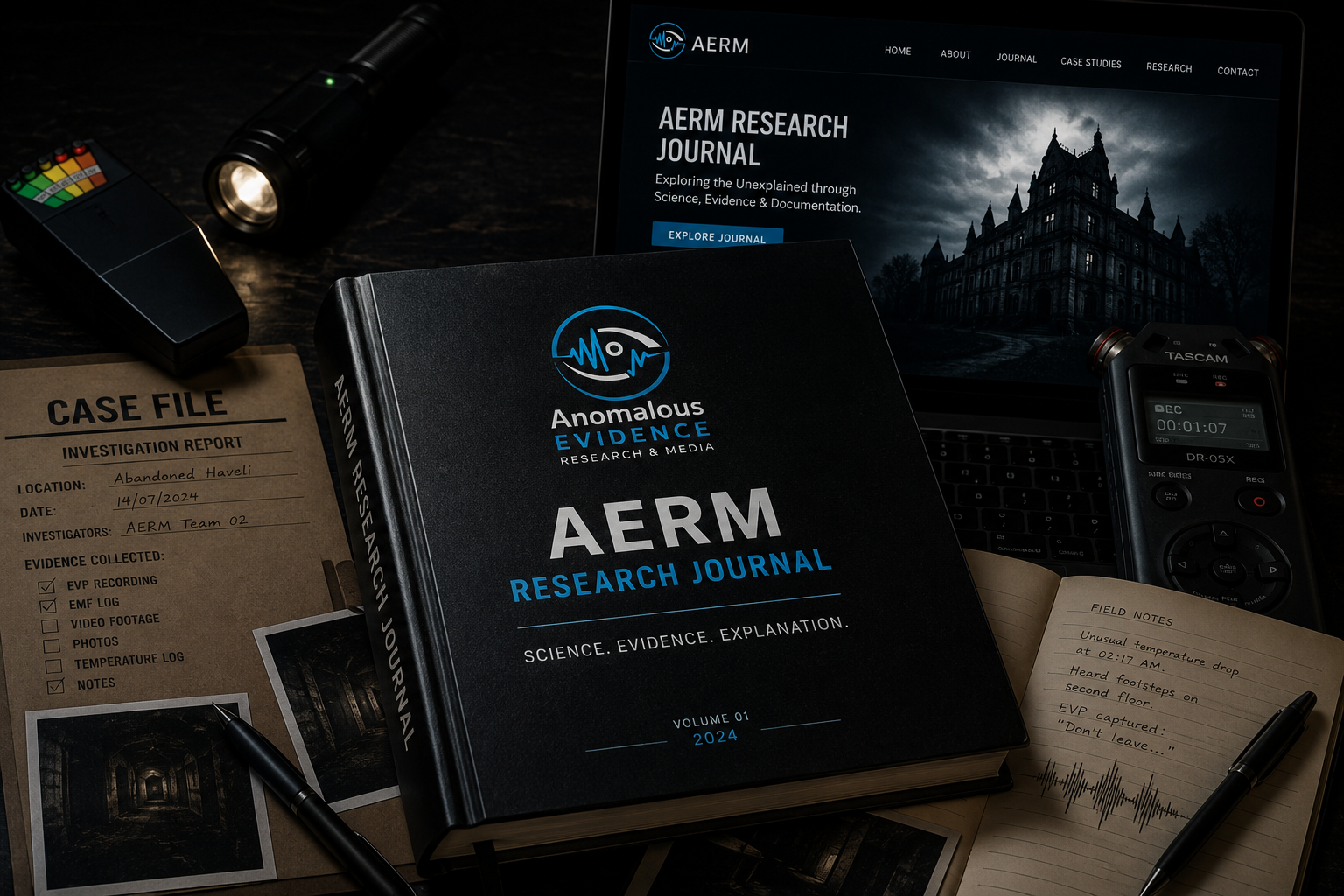
Research Ethics and Transparency in the Investigation of Unexplained Phenomena
Credibility is built through transparency, not certainty.
Investigating reports of unexplained phenomena requires more than technical equipment and field observations. It demands ethical responsibility, scientific discipline, and transparent communication throughout every stage of the investigative process.
At Anomalous Evidence Research & Media (AERM), research ethics form the foundation of every investigation. Our responsibility extends beyond collecting evidence—it includes ensuring that every observation is documented accurately, interpreted objectively, and communicated honestly to both participants and the public.
Scientific integrity is not demonstrated by claiming extraordinary conclusions. It is demonstrated by openly acknowledging what is known, what remains uncertain, and what requires further investigation.
---
Executive Summary
AERM's ethical framework is built upon five core principles:
- Integrity in evidence collection
- Transparency in methodology
- Objectivity in analysis
- Respect for participants and communities
- Responsible public communication
These principles guide every stage of an investigation, from the initial case assessment to the publication of research findings.
---
Why Research Ethics Matter
Research involving unusual or unexplained experiences often attracts significant public attention. Without ethical standards, investigations can become influenced by confirmation bias, sensationalism, selective reporting, or commercial interests.
Ethical research practices help ensure that:
- Evidence is collected responsibly.
- Observations remain objective.
- Participants are treated respectfully.
- Findings are communicated accurately.
- Public trust is maintained.
Responsible investigation is not about proving extraordinary claims—it is about documenting observations with honesty and scientific rigor.
---
Scientific Integrity Before Conclusions
One of the most important responsibilities of any research organization is to separate observation from interpretation
An unusual observation does not automatically indicate an extraordinary cause.
For this reason, investigators should avoid making definitive conclusions before sufficient evidence has been collected, verified, and critically evaluated.
Scientific integrity requires investigators to ask:
- What was directly observed?
- What evidence supports this observation?
- What alternative explanations exist?
- What information is still missing?
- Can the findings be independently verified?
This approach reduces bias and encourages more reliable conclusions.
---
Transparency in Investigation Methodology
Transparency allows others to understand how an investigation was conducted and how conclusions were reached.
AERM documents every investigation using standardized procedures, including:
- Investigation objectives
- Site description
- Environmental baseline measurements
- Equipment inventory
- Observation timeline
- Evidence collection methods
- Analytical procedures
- Alternative explanations considered
- Final assessment
- Study limitations
Providing methodological transparency allows independent reviewers to evaluate the quality of the investigation rather than relying solely on its conclusions.
---
Evidence-Based Reporting
Evidence should always be presented in its original context.
Responsible reporting includes:
- Accurate timestamps
- Environmental conditions
- Equipment used
- Observation logs
- Supporting photographs
- Audio or video documentation
- Measurement data
- Analytical notes
Evidence should never be altered to strengthen a narrative or support preconceived beliefs.
Whenever uncertainty exists, it should be explicitly acknowledged rather than concealed.
---
Avoiding Sensationalism
Public interest should never outweigh scientific responsibility.
Sensational headlines, exaggerated language, or unsupported conclusions may attract attention temporarily, but they ultimately undermine public trust and reduce the credibility of legitimate research.
AERM is committed to presenting findings in a balanced and evidence-focused manner.
Rather than asking:
"Can we prove something extraordinary?"
We ask:
"What does the available evidence actually support?"
This distinction is essential for maintaining professional standards.
---
Respect for Participants and Communities
Investigations frequently involve individuals who have experienced unusual events that may have caused genuine concern or distress.
Researchers have an ethical obligation to:
- Listen without prejudice
- Respect privacy
- Protect confidential information
- Obtain informed consent
- Avoid exploiting personal experiences
- Represent witness statements accurately
Maintaining respectful relationships with participants is fundamental to responsible research.
---
Considering Alternative Explanations
Responsible investigation requires careful consideration of conventional explanations before proposing anomalous interpretations.
Investigators evaluate factors including:
- Environmental conditions
- Structural characteristics
- Weather influences
- Wildlife activity
- Acoustic reflections
- Lighting conditions
- Electromagnetic interference
- Human perception
- Psychological influences
- Equipment limitations
Considering alternative explanations does not dismiss unusual observations—it strengthens the overall quality of the investigation.
---
Managing Uncertainty
Scientific research rarely produces absolute certainty.
Some investigations conclude with clear explanations.
Others remain inconclusive.
A small number may contain observations that cannot currently be explained using available evidence.
Acknowledging uncertainty is not a weakness.
It is a hallmark of responsible scientific practice.
AERM therefore classifies findings based on the strength and quality of available evidence rather than attempting to force definitive conclusions.
---
Transparency in Publication
Research publication represents the final stage of an investigation, but it also carries significant responsibility.
Before publication, reports should be reviewed for:
- Accuracy
- Internal consistency
- Evidence quality
- Methodological clarity
- Ethical compliance
- Respectful language
- Appropriate conclusions
Only information supported by documented evidence should appear in public reports.
Where uncertainty exists, it should be clearly identified.
---
Ethical Use of Images and Media
Visual documentation can significantly influence public perception.
AERM therefore follows responsible practices including:
- Preserving original files
- Documenting image sources
- Avoiding misleading editing
- Providing contextual information
- Clearly identifying enhanced images where applicable
Media should support documentation rather than create dramatic narratives.
---
Accountability and Continuous Improvement
Ethical standards should evolve alongside advances in research methods, technology, and scientific understanding.
AERM is committed to regularly reviewing its investigative procedures and publication practices to improve:
- Documentation quality
- Evidence management
- Data transparency
- Analytical consistency
- Public communication
Constructive peer review and independent evaluation are welcomed as opportunities for continual improvement.
---
Conclusion
Ethics and transparency are fundamental to credible investigation.
They influence not only how evidence is collected but also how research is interpreted, communicated, and preserved for future study.
By prioritizing integrity over sensationalism and evidence over assumption, AERM seeks to contribute meaningful, responsible, and scientifically grounded research to the study of unexplained phenomena.
Our commitment remains unchanged:
Evidence Before Assumption. Transparency Before Conclusion.
---
References
The ethical principles discussed in this article are informed by internationally recognized standards in scientific research, evidence management, environmental investigation, academic publishing, and responsible science communication. Future publications will include detailed references to peer-reviewed literature and relevant professional guidelines where appropriate.
---
About AERM
Anomalous Evidence Research & Media (AERM) is an independent research organization dedicated to the evidence-based investigation of unexplained reports through scientific methodology, environmental analysis, critical evaluation, and transparent documentation.
---
Disclaimer
This publication is intended for educational and research purposes. AERM does not promote extraordinary claims without supporting evidence. Conclusions presented in our publications are based solely on documented observations, available data, and systematic analysis conducted during each investigation.